

“There are some very positive changes in the U.S. market, becoming evident, especially at the end of Q4(‘24) and in early 2025. These changes include the recent launches of new products onto the U.S. market, which have been extremely well received by consumers. The pace of change, which we’re seeing in the past month, is unprecedented.” – Gavin O’Dowd, Haypp Group CEO, Q4’24 Call
For Haypp Group, to refer to 2024 as an ‘eventful’ year would be a gross understatement. Q1’24 showcased the group’s Pricing Gaps versus competition, supporting its scale economies shared model. In the second quarter, multiple metrics and market dynamics pointed to the company being Further ahead. Yet, later into the year, Tremors occurred, fostering uneasiness and ultimately forcing the company’s trajectory into a partial Rerouting.
Mind you, a partial rerouting considers the path and does not necessarily change the ultimate destination. It has been approximately a year since I first shared my thesis on the company, and the results following Q4 have loudly answered many recent concerns. Further, the figures provided by Haypp and major manufacturers such as Philip Morris International, Altria, and British American Tobacco suggest the trajectory of the nicotine pouch category is still profoundly underestimated.
Haypp Group: Ahead of the Nicotine Pouch Megatrend

“The consumer demand continues to increase, and the volume of nicotine pouches has grown by 46% during the quarter relative to Q4 2022. This is 2 percentage points higher than the 44%, which we grew for the full year. And on the back of this, nicotine pouches accounted for 56% of the group volume during the fourth quarter. We have seen strong growth in …
The core of it
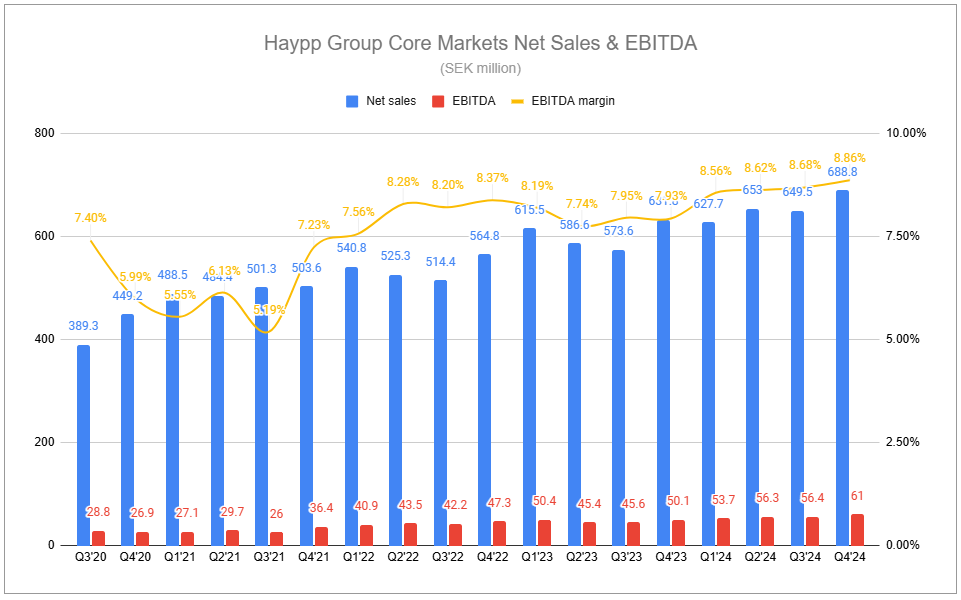
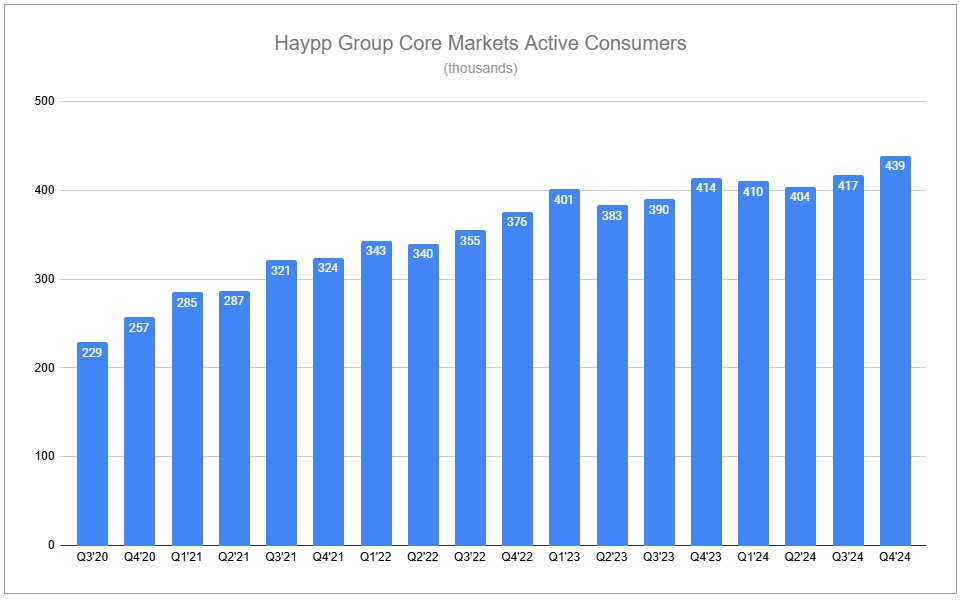
Haypp’s Core Markets remain remarkably consistent. Cannibalization from nicotine pouches has sustained the elevated decline rate of snus. Competition in the NP space remains fervent, with new products and iterations introduced rapidly. Online penetration remains high, and Haypp retains the lion’s share of the online market. Although this segment does not have the same ‘flash’ as the aptly named Growth Markets, growth is indeed being achieved. Segment net sales in Q4’24 grew by 9% and were up 8.8% for the year. More impressively, through continued scale, positive mix shift, and incremental benefit from Media and Insights, segment margins have steadily expanded, and EBITDA grew by 21.7% and 18.7% for Q4’24 and FY’24, respectively. Not exactly a snail’s pace.
The segment’s prominent trouble was that an authority body in Stockholm overseeing tobacco product licensing voted 3-2 to revoke the group’s license. I previously expressed my lesser concern for this point, as the supposed reason for the revocation appears well-addressed and bodes well for the appeal process. Such a license concerns only tobacco products, not nicotine pouches, but there was the consideration of the group losing a degree of operating leverage if the appeal process led to an unfavorable outcome. Still, it would likely only be reached 12-24 months out—a timeline the group again reaffirmed within its full-year report. By the time that bridge would have to be crossed, snus would have declined more, while pouches would have made up a far more significant portion of segment volumes and net sales. Diminishing concern for the revocation to an even greater degree, the group also confirmed speculation that it had acquired a second tobacco product license. This was done by acquiring a small cigar retailer in Sweden with a license from an authority body in a different municipality. This action largely eliminates the would-be pains.
What growth?
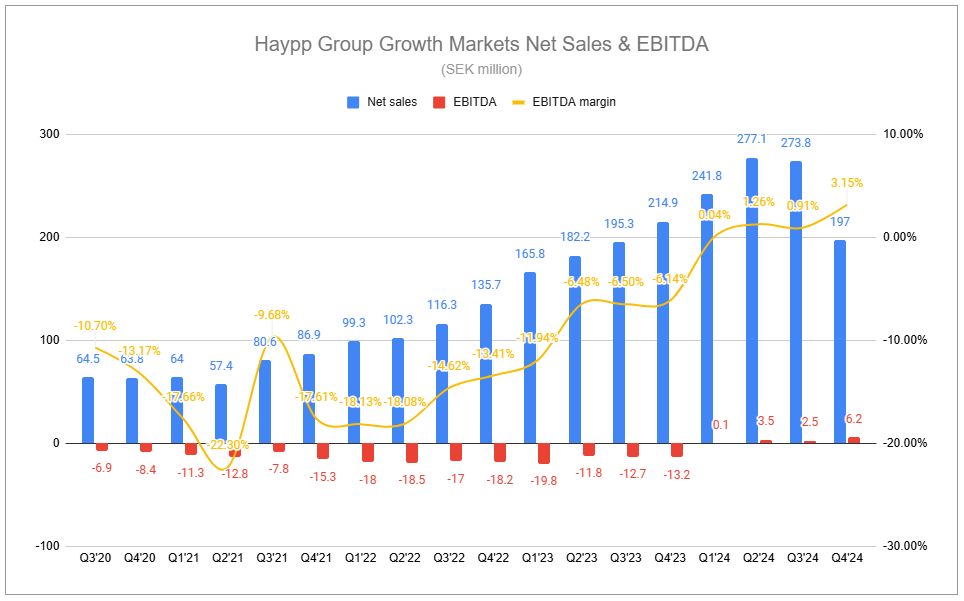
The smaller constituents of Haypp’s Growth Markets, such as the U.K. and Austria, continued on a rapid upward trajectory throughout 2024. However, the developments within the largest component of the segment, the United States, caused Q4’24 to look ungrowth-like. As if a set of dominoes, the lawsuit filed by San Francisco led to the immediate self-elected suspension of sales in the state. Sales in other select states were paused as well. Since a large portion of the group’s legacy oral tobacco product sales were sold in California, the winddown of legacy oral tobacco sales across the entire country was accelerated. Add in the effects of the ZYN shortage followed by Haypp being unable to stock the product, and specific metrics for Q4 looked less than stellar, to put it mildly. Despite full-year segment active consumers being up by more than 47%, in Q4’24, they were down by 8.3% y/y and down 39% sequentially. The segment topline decelerated to 30.5% growth for the year, with Q4’24 down by 8.3% y/y and down 28% sequentially.
Little distance has been covered in reaching a settlement with San Francisco, so the resumption of sales within California should not be assumed to be soon. Although the exact settlement amount is unknown, the group’s figure remains unchanged, and it is supported by the size of the settlement SMNA reached with D.C., involving fairly similar circumstances. It would be easy to stop there, but digging deeper into the figures makes it apparent that Q4 ’24 provided a significantly more potent performance than otherwise suggested.
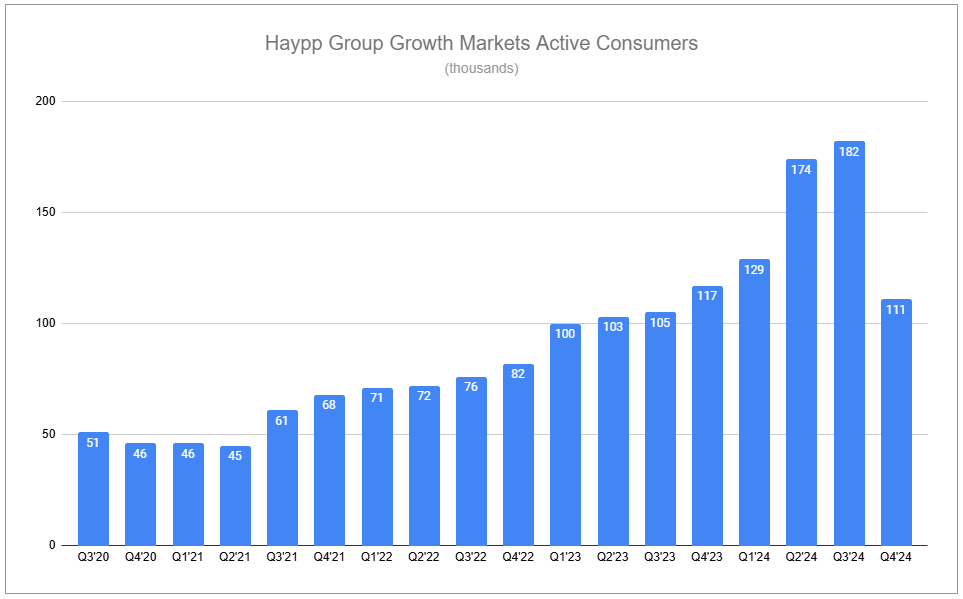
A portion of the significant drop in Growth Markets’ active consumers was from pausing sales in several states. Another part relates to consumers of legacy oral tobacco products. The third contributor was Haypp having ZYN out of stock. I said in my Q3’24 note:
One concern has been concentration risk—ZYN accounts for a large part of Haypp’s US sales. If you hypothesize that ZYN is integral to Haypp’s competitive position in the United States, the current real-world setup is probably a better test than anything you could dream up in a lab.
When Haypp saw an uptick in users earlier in 2024 due to the ZYN shortage, management expressed uncertainty about the degree of retention that would be achieved. Sure enough, with ZYN restocking incrementally occurring at the physical retail level, part of the drop in active consumers appears to reflect transient cohorts. This was also addressed in last quarter’s note, which went on to identify the crux of the matter (emphasis added in bold):
The spike in online channel adoption resulted in Haypp’s traffic from organic search increasing by 101% y/y in the United States in Q2’24. Despite having ZYN available, sales per consumer were capped, driving sales of non-ZYN pouch brands up by 121% y/y. But there were several caveats. If the ZYN shortage drove this, any improvement in availability within physical retail channels could unwind it. ZYN rationing and non-ZYN sales drove down the average dollar order size. At the time, Haypp admitted there was uncertainty regarding the retention rates of these new consumer cohorts. Although PMI is increasing capacity, and the physical retail channel is improving ZYN availability, in Q3’24, Haypp’s non-ZYN pouch sales in the United States increased by 130% y/y, excluding California. It appears that retention is pretty robust.
The real questions are: To what extent do Haypp’s non-ZYN pouch sales continue, and does the company manage to retain the majority of active consumers? The only way that would-be ZYN sales would result in 0 in Q4’24 would be if there were no alternative products. But there are alternatives.
Although active consumers and net sales for the Growth Markets segment were down in Q4’24, the gross margin for the group and EBITDA for the segment were up markedly. Explaining these developments are two intertwined drivers.
The first driver is mix shift, also highlighted in Q3’24:
But wait, you say! At much lower prices, this should materially reduce average dollar order size and Haypp’s net revenues from associated sales. This is correct but does not have wholly negative implications. ZYN is the most well-known brand in the United States. It is priced at a premium. To spur consumer trial and repeat purchases, other brands undercut ZYN and sport a lower retail price. However, other brands also carry lower list prices at wholesale. The differential between wholesale and retail prices of these products is wider than that of ZYN. Therefore, despite retail prices being meaningfully discounted, other brands typically carry more favorable unit economics for Haypp.
U.S. nicotine pouch sales, excluding ZYN and suspended states, increased radically in Q4’24. The favorable unit economics of these products shined despite a loss of total throughput. And, since legacy oral tobacco product sales didn’t end immediately at the start of Q4’24 and were wound down throughout the quarter, this development is instructive for Q1’25, when legacy oral tobacco product sales in the U.S. will be absent.
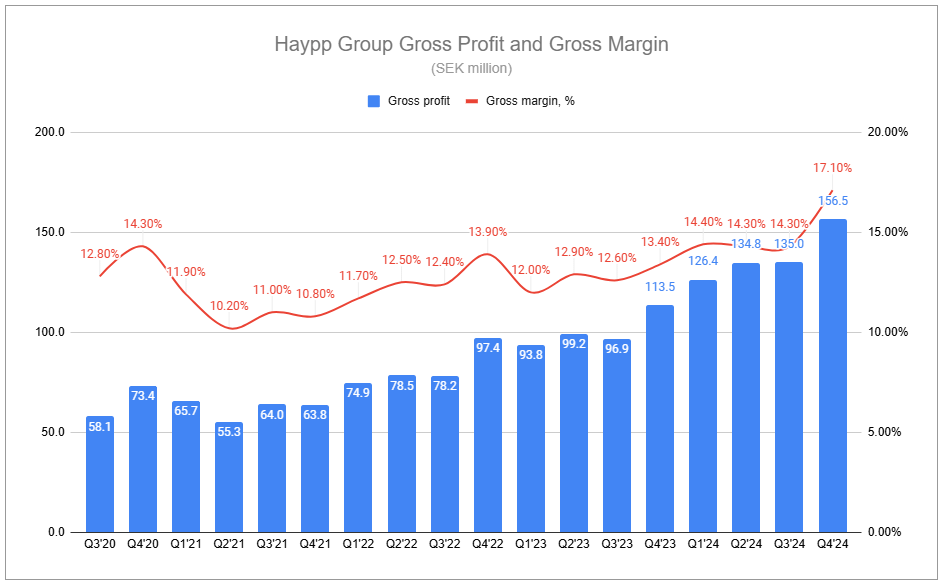
Another major driver of material improvement in the financial performance of the Growth Markets segment, and gross margin for the group as a whole, was Media & Insights. Fundamentally, this is the lifeblood of this business, supported by non-replicable historical data, along with the technical infrastructure that competition does not have, allowing Haypp to drive incremental returns without sacrificing the savings it actively passes to consumers. Historically, Media & Insights have mainly been composed of Core Markets activities. This is changing.
Numerous factors drive Media & Insights. One is the number of competitors in the category, the number of new entrants, and potential new entrants. Another is ‘surface area,’ which comprises the types of data that can be attained and utilized, along with the total real estate across Haypp’s portfolio of websites into which Media can be applied. Third is the degree of efficiency Haypp produces for itself and brand owners. All of these are increasing meaningfully, and they are further magnified by the absolute size of the market, which is growing rapidly and dictates the levels of spend that brand owners can rationalize.
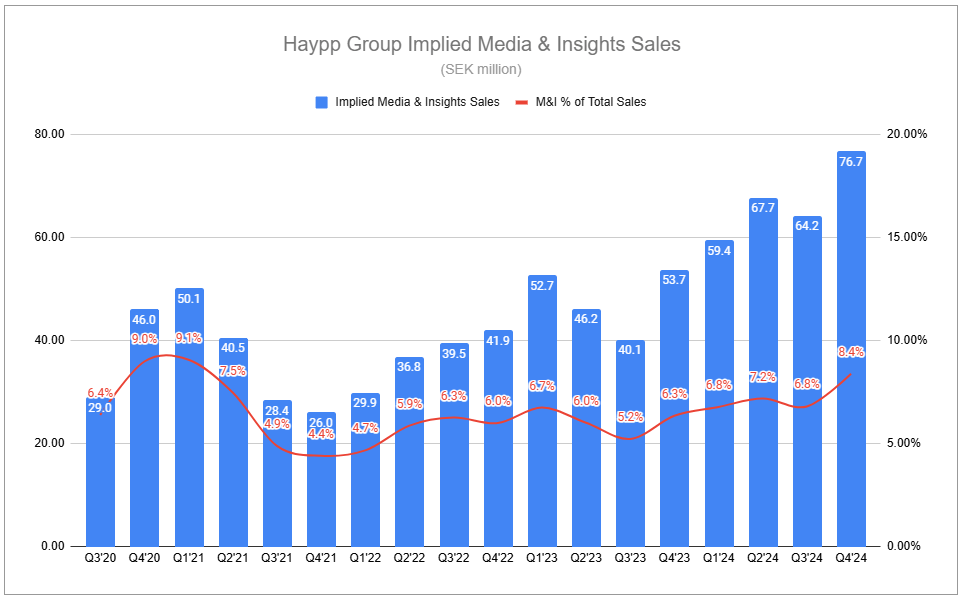
Implied Media & Insights sales is imperfect due to accounting treatments. Nonetheless, it acts as a helpful ballpark figure to reference. Historically, Q1 of each year experiences an uplift from Media & Insights contribution. However, throughout 2024, implied sales increased at a materially elevated rate. New product launches and a meaningful increase in the size of the pouch market in the U.S. throughout the year undoubtedly helped drive this. But it was also likely amplified by the ZYN shortage and the suspension of sales on zyn(dot)com, providing an opportunity for other brand owners to spend more across all channels to capture incremental share.
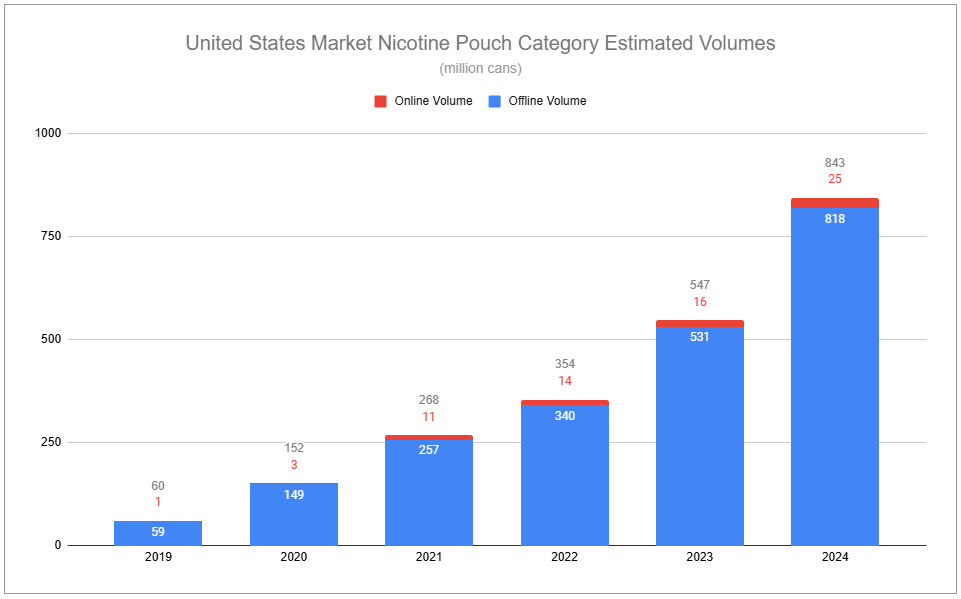
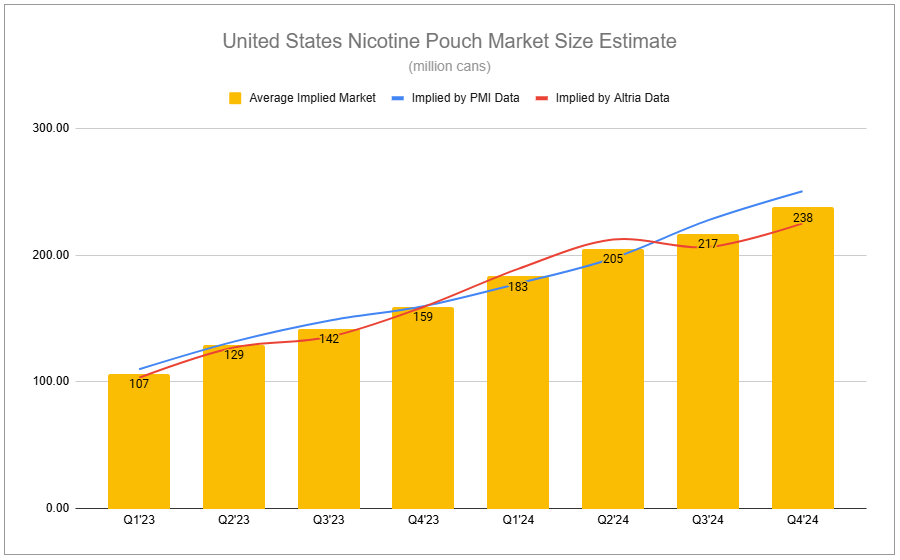
Haypp’s estimates above capture the rapid rise of nicotine pouches in the United States and highlight how little online sales are—only roughly 3% in 2024. Estimating the entire size of the legal pouch market in the U.S., I reached similar figures using data available in PMI and Altria filings below.
There is much debate on what will happen in the U.S. market over the next few years. Even what is currently unfolding, especially concerning Haypp, is a bit murky. Will ZYN recapture volume share as production capacity reaches demand? As ZYN becomes comfortably back in stock across the physical retail channel, will more of Haypp’s consumers be proven temporary? If and when Haypp regains stock of ZYN, will consumers shift away from higher-margin products?
To lay out what I believe is occurring, it’s essential to explore how the nicotine pouch market is measured. Historically, manufacturers rely on scan data provided at the retail level to estimate market share. Due to this, extrapolating the market’s size for any short period will be fuzzy if you’re taking share data and referencing shipped volumes, as I have done. Nonetheless, the numbers should be able to provide a close enough figure over a longer period. But we need to look beyond the approximate number of cans sold. The number of actual pouches must also be considered.
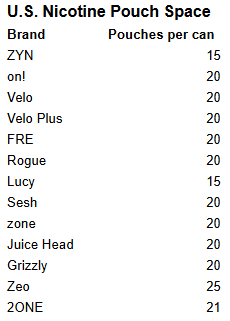
Only one brand, Lucy, has 15 pouches per can like ZYN. While of good quality, this brand makes up a rounding error for total share. Likewise, pouches with more than 20 pouches per can make up a trivial part of the market. To understand why this matters and for further context, let’s revisit an exchange during PMI’s Q3’24 call between Goldman analyst Bonnie Herzog and Philip Morris International’s CFO Emmanuel Babeau (emphasis added in bold):
Bonnie Herzog:
Yes. Okay. All of that makes sense and it's really helpful. And then maybe a second question on ZYN. So the supply constraints appear to be easing, which is great. So just wanted to confirm, Emmanuel, that you are on track to fully restore supply levels this quarter? Or is there a chance this bleeds into maybe early next year? And then when this happens, how quickly do you expect ZYN to recapture some of the lost market share? And just curious what role will potential stepped up promos play, I guess, if at all? How are you thinking about that?
Emmanuel Babeau:
Sure. On ZYN, Bonnie, we said somewhere in Q4, we will have the supply to the market meeting consumer demand. Which to clarify again, doesn't mean that we will have fully been replenishing all level of inventory. Here at that point, we believe for what we can assess of the consumer demand that what we bring to the trade will correspond to what the consumer will take from the trade, will buy from the trade. But then there will certainly be -- and I'm not able to tell you when it's going to happen during this quarter.
But I think we are still in this perspective then, but that's probably more for 2025, there will be a replenishment of the out-of-stock situation. And we will gradually -- but that's going to happen only gradually probably through 2025, put back the level of inventory to what it should be normally and that certainly will take some months as we continue to increase the capacity. Remember, we said that for the full year 2025, we are targeting an overall capacity of around 900 million cans. Of course, that is a capacity that we are going to build gradually.
It won't be there at the beginning of the year. And I would say the replenishment and being back to a fully normal situation is going to happen only gradually through 2025. And of course, when we can be more specific about that, we will be more specific with the topic. So that's for supply.
When it comes to regaining share. So what we've seen is that -- in fact, when the availability of ZYN went down, we've seen the category slowing down because, obviously, it seems that a number of buyers of ZYN are not intending to buy another brand. And therefore, when they don't find their ZYN, they are maybe probably using or consuming something else. But that probably has been slowing down a bit the category. We will see how we gradually recover. We've seen in the second part of the Q3, some improvement sequentially on our market share, which is good news. We believe that we have some positive outlook as we regain availability for the product, but it's difficult to be more specific than that at that stage.
Having had a significant first-mover advantage and becoming a cognitive referent to the category, there is little doubt that ZYN holds a reasonable degree of brand loyalty. But the ‘slowdown’ can be reframed when considering that a consumer switching from ZYN to another brand is receiving roughly 33% more pouches per can. If they maintain the same consumption pattern, it will appear as a material deceleration if you are measuring on a per-can basis. When considered on a per-pouch basis, if ZYN loses incremental share, the degree of benefit to other brand owners will be greater. Further, normalizing onto a per-pouch basis illustrates that non-ZYN brands hold higher growth rates relative to ZYN than otherwise implied.
None of this is to say that ZYN is doomed—far from it. As expressed in my PMI full-year note, the company has the means to balance price, volume, and share to deliver strong returns. It’s impressive that the company has taken prices far higher while offering far fewer pouches per can, and it would be silly to expect the company to chase recapturing market share aggressively simply for the sake of market share. The point is that the market is already a bit more fragmented than believed. Considering relative pricing, value (pouches per can), and the higher-quality products now on the market, I also think it is on its way to becoming even more so.
The launch of Velo Plus minimally influenced Haypp’s significant growth of non-ZYN brands in the U.S. in Q4’24. I touched on the launch in my BAT full-year note:
Fortunately, the group’s willingness to back Velo Plus with the necessary resources may mask any prior mistakes. Reviews are exceptional, and, toe-to-toe, it exceeds ZYN qualitatively. Though it is unlikely to last for an extended period, BAT is also heavily subsidizing the product's price for now. When accounting for the difference in pouches per can, Velo Plus’ 20 to ZYN’s 15, the product is radically more affordable—near me, in Chicagoland, Velo Plus’ price per pouch roughly translates to being 65% cheaper than ZYN. This is an authentic product with real traction, and, as it was launched late in the quarter, in December, contributed minimally to FY’24 results.
BAT launched the product in early December, and Haypp only began to offer it halfway through the month—roughly 1/6 of the quarter. There is one concern: As BAT is heavily subsidizing the price of Velo Plus through promotions, there has not been a wide price disparity between physical retail and Haypp’s online, diminishing the group’s value proposition for the brand. However, also touched on in the most recent BAT note, the special introductory price is unlikely to be sustained for long. It is aimed at boosting initial trials to build momentum for the brand. Judging by retail data running through the first two months of 2025, critical mass to sustain such momentum is attainable. This product is growing rapidly, far outpacing the category’s strong growth.
Haypp’s management expects U.S. volume growth throughout 2025 to evolve similarly to Q4’24, even without getting ZYN back in stock. Should the company regain ZYN stock, there should be a material draw to recapture churned consumer cohorts, ultimately driving net sales and higher average order sizes. Margin may be weighed down relative to if those same order volumes would have been other brands. Still, with greater scale, the meaningful uptick in volumes should offset this with infrastructure that is now automated, driving down fulfillment costs on a per-order basis. PMI expects to have ZYN production meet demand parity and reach normalization roughly halfway through 2025. There is an expectation for Haypp to regain ZYN stock in the U.S. before this, but there are now special considerations. Although they could been viewed as an additional challenge for Haypp, I believe the situation is far more favorable.