

“It is the small things in life which count; it is the inconsequential leak which empties the biggest reservoir.” - Charles Comiskey
Snow is on the ground, providing a quiet peace. Time moves a bit more slowly during winter, but it surely is quick around the holidays, and in much of the business world, ‘calm’ is only ever a fleeting thought. Let’s tie up some odds and ends of recent developments in the U.S. nicotine market.
On the plus side

I have remained deeply critical of British American Tobacco’s approach to the Modern Oral market in the United States. As stated in my latest BAT note, the company’s one bright spot is the newly launched Velo Plus. Early consumer reviews and retailers’ perspectives have been overwhelmingly positive. I’ve gotten my hands on several SKUs and can provide further opinions.
Velo Plus is not as moist as the ‘2.0’ Scandinavian Velo. But on the plus side, it holds several standout qualities. First, the cans are a significant upgrade from Velo 1.0’s flimsy plastic and haphazard labeling. They are virtually identical to the cans of Scandinavian Velo and similar to all of the high-quality cans found in other markets, with durable plastic, clean labels, and a pop-top to discard used pouches. The only other U.S. brand with similar high-quality packaging is zone. When opened, the Velo Plus pouches provide a strong aroma. While they are not as moist as the Scandinavian variant, they are indeed more moist than all other products currently available in the U.S. market. They are also more filled than zone, making them more plush. The flavors aren’t intense, but each has an appropriate and long-lasting profile. More importantly, the delivery speed is top-notch. Overall, this is an unmistakably high-quality product that lives up to the excitement expressed by management.
BAT’s significant relationships with distributors and retailers have allowed a rapid rollout. The product is now available online on Haypp Group’s websites, and I would expect the brand’s presence to fill out most of the company’s U.S. footprint throughout 2025. ZYN’s capacity constraints, even as they have lessened, have presented a window for other brands to a better position within the U.S. market. Velo Plus appears to be subsidized by BAT to spur greater consumer trial, priced under most other brands, including Velo 1.0, across many retail outlets. The relative value proposition contrasts more sharply, considering each can contains 20 pouches versus ZYN’s 15.
The one hangup remains BAT’s disjointed approach to the U.S. market. Many consumers remain confused about whether Velo Plus is merely another brand refresh, Scandinavian Velo, or an entirely new product. It is up to the group to deliver a concise, clear message.
PMI settles
In June 2024, PMI’s U.S. subsidiary, Swedish Match North America, received a subpoena from the District of Columbia AG, seeking information regarding compliance practices related to flavored tobacco product sales in Washington, D.C. Following the subpoena, SMNA swiftly shut down all e-commerce sales on the standalone zyn (dot) com website. Sales from the website made up a small percentage of the group’s pouch sales in the United States, resulting in an inconsequential financial impact. However, the orders were fulfilled by Scandinavian Tobacco Group, whose sales were impacted to a greater degree.
On December 13th, 2024, SMNA announced it would pay $1.2 million to settle the investigation. This marks another inconsequential financial impact. However, the indirect impacts may be more pronounced. During Scandinavian Tobacco Group’s Q3’24 call, the group announced that its involvement in the e-commerce sales of ZYN in relation to zyn (dot) com has firmly ended. STG also expected that sales on zyn (dot) com would unlikely resume with another partner in place. Without DTC sales, the standalone website would act to establish brand equity further, allow verified adult consumers to redeem ZYN rewards, and provide consumers a way to find physical retail locations selling the product. While PMI itself has not stated whether or not DTC sales will resume, STG’s expectation that they will not is quite plausible. DTC sales require robust verification and compliance protocols. Any infractions can lead to blemishes on a manufacturer’s résumé. Using wholesalers exclusively provides an extra buffer to remove PMI further from culpability should any retailers fail to remain compliant at all levels. As PMTAs are still pending for ZYN, PMI appears especially sensitive to this dynamic and is acting conservatively.
Enforcement
In February of last year, following the scathing Reagen-Udall Report, the CTP provided a response highlighting actions the center would be taking. I noted a heavy focus on enforcement efforts. Fast-forward nearly two years to the present day, and while much is left to be desired, enforcement has undoubtedly stepped up. We have seen actions taken by the DOJ and the U.S. CBP. The FDA has sent droves of warning letters and many civil money penalties. Its most recent action was announced earlier this month when it issued 115 warning letters to retailers selling illicit vapor products.
A principal concern is that as the Modern Oral category rapidly grows, so too will an illicit market, mirroring the trajectory of vapor. However, brand owners, such as PMI, have already begun to take action internally to thwart the importation of their foreign products. Enforcement agencies, building and utilizing tools to combat illicit vapor, have begun to port efforts to clamp down on illicit pouch volumes more rapidly, targeting larger foreign sites shipping into the country.
Arguments galore
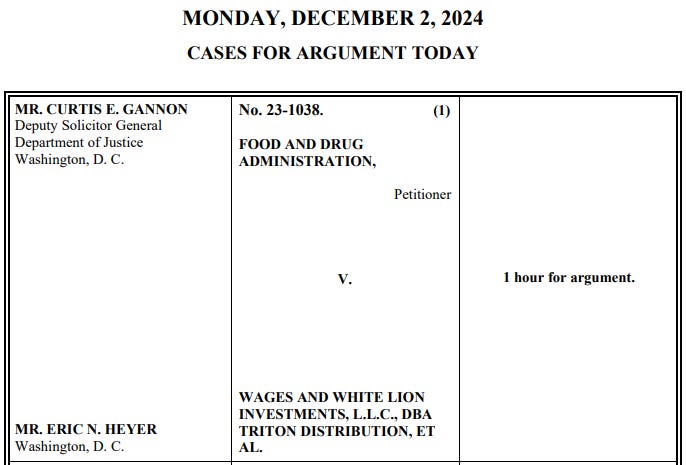
One of the most anticipated oral arguments of the year was The Food and Drug Administration v. Wages and White Lion Investments L.L.C., DBA Triton Distribution, Et Al., concerning the administration’s PMTA process and alleged goal post-moving and arbitrary and capricious practices. Had the Supreme Court of the United States been sympathetic toward Triton, there was an expectation that the FDA would have conceded to processes equivalent to substantially lowering the bar for receiving Marketing Granted Orders via the PMTA pathway, ultimately easing the playing field for many small, independent manufacturers and distributors. Unfortunately for Triton, while many of the FDA’s processes seem deeply flawed, the language used indicates that, thus far, the Supreme Court remains unconvinced. We will not have a decision until halfway through 2025.
Altria v. Reynolds
In 2022, a jury found that Reynolds Vapor’s (BAT) Vuse Alto infringed upon patents owned by Altria. Reynolds appealed.
Reynolds raises four issues on appeal. First, Reynolds argues that the district court erred in denying its motion for JMOL or a new trial on infringement. Second, Reynolds argues that the district court improperly excluded evidence of its invalidity defense and that a new trial on invalidity is warranted. Third, Reynolds argues that, given its challenge to the calculation of a per-unit royalty rate from a comparable license, the district court improperly denied its motion for JMOL or a new trial on damages. Fourth, Reynolds argues that the district court improperly allowed the jury to hear testimony from Altria’s damages expert on apportionment and that this error requires JMOL or a new trial.
Last week, a U.S. appeals court, unsympathetic to Reynolds, upheld the verdict awarding Altria $95,233,292 in damages “for past infringement through June 30, 2022.” Additionally, the appeals court found that the royalty rate Altria would receive for continued sales of Vuse Alto, 5.25%, was not based on speculation or guesswork, nor was grossly excessive or monstrous.
Politicking
A selected FDA commissioner whose prior comments seem somewhat apathetic toward the idea of Tobacco Harm Reduction, if not opposed to new product categories, does not inspire meaningful change. The wildcard is the appointment of Robert F. Kennedy Jr. as secretary of the Department of Health and Human Services. With the FDA as part of HHS, RFK Jr.’s outspoken views suggest that significant shakeups should be anticipated. However, RFK Jr. appears fixated on the “Food” and “Drug” activities of the administration, and his views towards tobacco and nicotine are nowhere as detailed. He has, at times, highlighted criticisms of the marketing practices of tobacco majors. However, he also appears to be a user of nicotine pouches. At the same time, there is JD Vance, who, anecdotally, is surrounded by a team who heavily use nicotine. Will personal preferences influence outcomes? It wouldn’t be the first time, and it would be far from the last. Add in the newly devised ‘DOGE’ team, and will the FDA CTP see some chopping going on, reducing the friction of getting new products onto the market? It’s unlikely, but I won’t be surprised if the CTP’s practices and the treatment of NGPs become politicized to a greater degree.
Lacking the same degree of speculation is that with a Republican president and a Republican majority in Congress, the menthol ban is off the table, and an increase in Federal-level excise taxes appears unthinkable. Reaching any conclusion other than the 2025 environment bodes well for legacy tobacco products in the U.S. is difficult.
Merry Christmas.
If you enjoyed this piece, hit “♡ like” on the site and give it a share.
Questions or thoughts to add? Comment on the site or message me on Twitter.
Ownership Disclaimer
I own positions in tobacco companies such as Altria, Philip Morris International, British American Tobacco, Scandinavian Tobacco Group, and Imperial Brands. I also own positions in Haypp Group, a major online retailer of reduced-risk nicotine products.
Disclaimer
This publication’s content is for entertainment and educational purposes only. I am not a licensed investment professional. Nothing produced under the Invariant brand should be thought of as investment advice. Do your own research. All content is subject to interpretation.
Tags: MO 0.00%↑ PM 0.00%↑ BTI 0.00%↑
Merry Christmas to you and all your readers, and congratulations on the continued progress of your newsletter!
Regarding enforcement, I see this playing out in (at least) two possible ways:
One perspective is cyclical - illegal tobacco products have always been introduced, and after some time enforcement catches up. Gavin O’Dowd recently mentioned “if you go back for the last 70 years, there’s always been waves of illicit products getting into every market in the tobacco and nicotine space (…) and eventually it becomes such a material issue that the government simply says we’re going to put a boot on this”. https://m.youtube.com/watch?v=OaFNvUuyUsE
The other perspective is that US state capacity has been declining for decades: https://onlinelibrary.wiley.com/doi/10.1111/1758-5899.13282. For instance, you have written extensively on the PMTA process, in which the FDA has been unable to evaluate applications on time, has arbitrarily rejected some applications, and has created the perverse situation in which most of the vapes sold in the US are illegal.
I’m sure nothing is as black and white as I’m suggesting. What is your view?