

“The true adventurer goes forth aimless and uncalculating to meet and greet unknown fate.” - O. Henry
United-Guardian’s 2024 performance finished in a rather unspectacular fashion. Shortages leading to a decline in net sales in one segment were handily offset by recoveries elsewhere. Investment income ratcheted up meaningfully, though costs continue to climb higher, driven by growth ambitions yet to materialize. New positive and negative catalysts linger, but there is no certainty of their materializing or visibility in the timeline.
Cosmetics and Medical
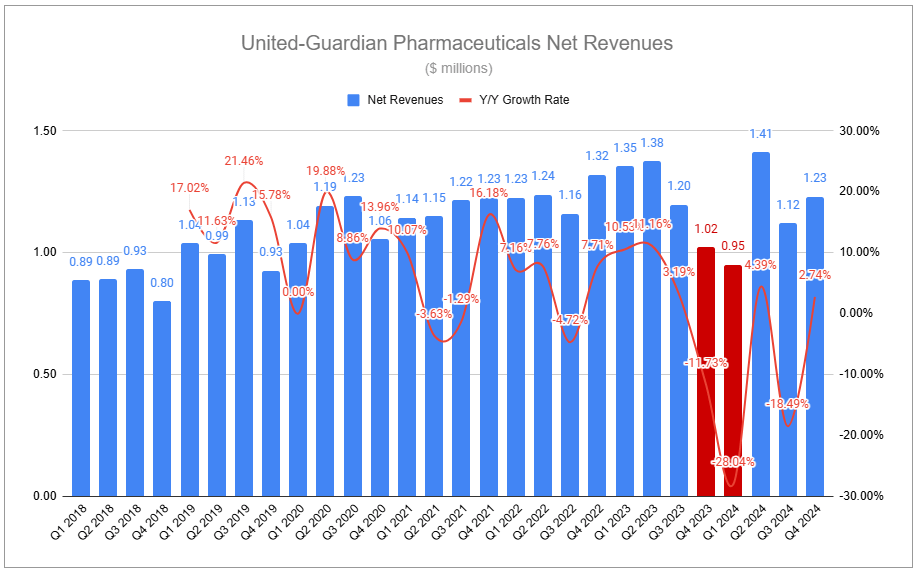
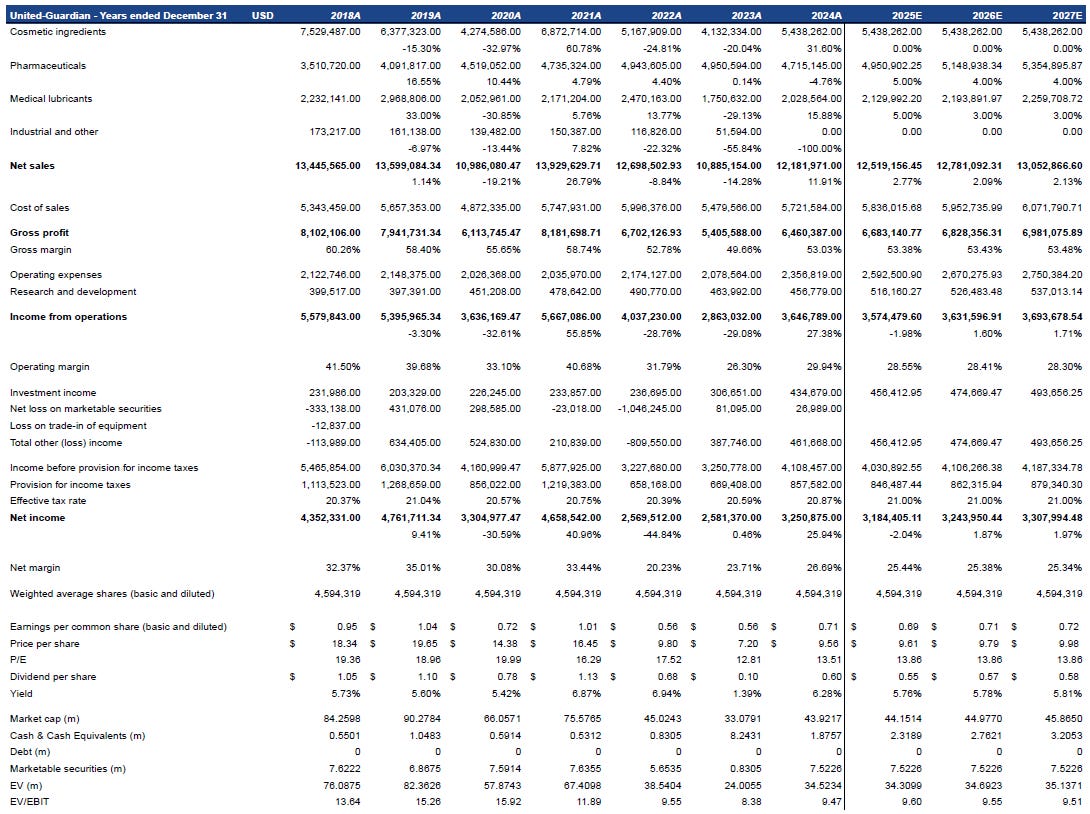
United-Guardian’s Cosmetic Ingredients segment posted a significant rise in net sales in 2024, up 31.6% from the year prior. Ashland, the company’s largest distribution partner, experienced a sharp rise in demand from manufacturers in Asia, driving the bulk of the growth. The Medical Lubricant segment posted similarly strong growth in 2024, increasing by 15.9%. New distribution agreements, not just in Asia but also in Europe, point to a route to grow the business. However, results are bound to be lumpy, with no direct control over relationships with end-users that provide the demand.
Pharma
Supply shortages of UG’s key pharmaceutical, Renacidin, telegraphed late in 2023, were sustained into the latter part of Q1’24 due to the contract manufacturer responsible for producing the drug needing to modify its facility. If the timeline to resume production had been extended one additional quarter, there is little doubt that segment net sales would have been markedly lower for the year. Alas, no opportunity to acquire the equity at a significantly lower price was presented. Despite the disruption and ensuing volatility in sales, the full-year segment results were down by a mere 4.7% and nearly flat from two years ago.
Aimless
Following Beatriz Blanco’s resignation in June 2023, 2024 marked the first year United-Guardian had no CEO captain at the wheel. Although a veteran employee remains president, questions remain about where the ship is headed. Rather than filling that CEO role, in May 2024, the company hired a new marketing director. Within their skillset, they bring expertise in new product commercialization.
United-Guardian has struggled to grow its business lines despite continually sinking non-trivial sums into R&D each and every year of its existence. Presumably, the new hire is in conjunction with the company’s foray into Sexual Wellness products. Although an agreement was reached last year to distribute such products, and interest is supposedly high, not a single dollar in related net sales has been recognized. Granted, there is a lag time between initial awareness and interest and manufacturers identifying uses and adopting the group’s ingredients, so blossoming may begin in 2025. As alluring a proposition as that may be for a company of U-G’s very small size, my focus remains elsewhere.
Hiring the new marketing director not only brings potential to the new business line but also offers an opportunity to increase the existing business. Namely, with the normalization of Renacidin production, there is a distinct prospect to drive awareness of the pharmaceutical further and bolster the growth trajectory that followed the initial production-related shortages starting in 2010, the new NDA in 2014, and prior marketing initiatives beginning in 2018.
While aware of the growth drivers before the company, I am content to hold only a small tracking position. Considering how few eyeballs are on the company, there may be generous windows to act upon positive developments in future reports. But as the company takes aim, I am keen to see if the situation begins to look more aimless. Pursuing these initiatives promises to increase costs in 2025, and faltering is poised to diminish investor confidence even more. Further, with a lack of control and visibility into CI and ML segments, United-Guardian faces the looming uncertainty of tariffs. There is no telling if a full-blown trade war develops, but there is an appreciation that a large part of this business could be significantly affected if one does.
Halfway through last year, I noted that U-G’s shares trading at $15.32 could only be explained by the inexplicable influence of animal spirits. Such prices were indeed short-lived. With a large enough disruption, translating to diminished sales and profits, the illiquid equity, having only a few more than 300 shareholders, could experience a sharp movement in share price. While shares trade at $9.61 presently, I think back to November 2023 when they rapidly sank under $6. With the right mix of new pressures, it is not farfetched to think it could be pushed under $5 or even $4.
Such a scenario does not escape from the other unproven business issues. Still, the profits from pharmaceuticals would not be affected like CI and ML in the event of trade-war-induced pain. Notably, the company still holds zero debt and has a growing pile of cash and marketable securities. At such prices, depressed earnings could conceivably support a yield ranging near double-digit, and the cash and marketable securities would represent roughly half of the market cap. United-Guardian has endured for over three-quarters of a century and has remained profitable in nearly all years over the last several decades. Although the scenario may not materialize, the future is bound to present similar potentials.
Thanks for reading. Enjoy this piece? Hit “♡ like” on the site and share it.
Ownership Disclaimer
At the time of publishing this piece, I hold positions in United-Guardian.
Disclaimer
This publication’s content is for entertainment and educational purposes only. I am not a licensed investment professional. Nothing produced under the Invariant brand should be thought of as investment advice. Do your own research. All content is subject to interpretation.
Tags: UG 0.00%↑ ASH 0.00%↑
always great to see a new non-nicotine post !
Nice update Devin. The key point I would add, is that with the dividend raise to 70 cents annually, the current yield is 7.3%. This is an excellent example of being "paid to wait" for the value investor. With a return like that, I am tolerant of a certain amount of corporate aimlessness.
What a funny little R&D lab they have. They spend just under $500,000 a year, every single year. Results are thin, but at least they stay on budget! I picture a small team, probably have spent their entire careers at the same bench. I somehow doubt that Donna sends them a "What did you get done last week" email. For a company whose slogan is "Excellence through innovation", it is a bit murky about what they are inventing.