
Haypp Group: Engine for the New Environment

“The trees here are in misery, and the birds are in misery. I don’t think they sing; they just screech in pain. It’s a land that God, if he exists, has created in anger. Taking a close look at what’s around us, there is some sort of a harmony. It is the harmony of overwhelming and collective murder. And we, in comparison to the articulate vileness and baseness and obscenity of all this jungle, we only sound and look like badly pronounced and half-finished sentences out of a stupid suburban novel. And we have to become humble in front of this overwhelming misery and overwhelming fornication, overwhelming growth, and overwhelming lack of order. Even the stars up here in the sky look like a mess. There is no harmony in the universe as we have conceived it. When I say this, I say this all full of admiration for the jungle. It is not that I hate it. I love it. I love it very much, but I love it against my better judgment.” – Werner Herzog, Burden of Dreams, 1982
We need a jungle
I regularly talk with my friend Artem Fokin, founder and portfolio manager of Caro-Kann Capital LLC. At some point in our discussions over the past few years, he provided an excellent analogy for Haypp’s business in the United States: the United States market is like a savannah. It is flat, with few trees. There are pockets of tall grasses, but largely, there is exceptional visibility in every direction. The flora and fauna (competing nicotine pouch brands) exist in a defined equilibrium, with only slight observable change. This environment was shaped by the FDA, which roadblocked innovation.
This has been a fine environment for Haypp to operate in, but, as Artem has said, we need a jungle. A jungle, in this sense, represents overwhelming growth in competing brands, with owners who are willing to aggressively seed consumer awareness, trial, and adoption. There would be fierce territorial battles, and the rapidly changing conditions would act as dense foliage, sprawling vines, and a thick canopy, obscuring visibility. Traversing the terrain would be perilous for brand owners, necessitating the right tools to navigate.
The U.S. is not there yet. When I first wrote on Haypp Group in early 2024, I shared a range of trajectories for the U.S. market, concluding with one that shares a heart with Artem’s jungle:
“Counterintuitively, legal escalations do pose a separate threat from a competitive standpoint. ZYN, dominant in the United States, is largely so because it is the best of the first generation of dry pouches currently on the market. If the FDA concedes translating scientific substantiation of the product class’s reduced-risk profile into future modifications of its application process, it stands to reason that the door could potentially open wider for the hundreds of innovative products competing in Scandinavia. Although PMI has a pending PMTA for its moist pouch variant, heightened competition would challenge both the ability to retain market share as well as exercise price take.”
Undoubtedly concerning for incumbents, such a future is ideal for Haypp. The rapid growth rate of nicotine pouches in the US has occurred despite all available brands being ‘version 1s’ of what exists elsewhere. What if the door not only opens wider but is entirely blown off of its hinges? Perhaps it is a far less likely scenario, but it would be one that creates a Cambrian explosion-like event. Category growth would accelerate, and demand for Haypp’s services from adult consumers and brand owners alike would follow.
Since then, we have seen a handful of high-quality nicotine pouches enter the market. Competition has increased, with brand owners investing more heavily behind their products, challenging margins and market share. ZYN has steadily grown, but has also steadily lost ground.
The U.S. market has become increasingly fragmented, but rather than a savannah or jungle, it currently looks more like an ecotone, a boundary between the two biomes. Most ecotones are gradient-like, with greater total diversity, but edge cases can arise from human activities, such as construction, or, in this case, regulation. Mind you, ecotones are not immutable. They can disappear or collapse. When the right conditions are met, a jungle can easily creep outwards and take over surrounding areas.
The new environment
Ever since the FDA announced its pilot program to expedite pouch PMTA reviews in September 2025, there has been considerable discussion about its implications. In my Q4’25 note on Haypp, I stressed a key detail that I believe has received too little attention elsewhere (emphasis added in bold):
However, critically, it is not just the scope of new products that Haypp can benefit from. The potential of additional authorizations timed closely together would dramatically increase brand owners’ appetite to aggressively promote products, including purchasing more media at higher prices on Haypp’s websites. Coinciding with the wielding of Kevel, this could drive Haypp’s M&I significantly higher over the coming year(s).
On May 7, 2026, just hours after Haypp Group reported its Q1’26 results, the FDA published a CTP Acting Director Statement. It outlined ways the CTP intends to make its processes more efficient, including accelerating Filing Review, streamlining Scientific Review, and so on. It also touched on the pouch pilot program:
Applying the pilot’s lessons learned: No additional products will be added to the nicotine pouch pilot. Instead, because the pilot has realized significant success in accelerating review of nicotine pouch PMTAs, CTP intends to incorporate lessons learned from the pilot into the review for all nicotine pouch PMTAs.
As the release concluded with that statement and offered no timeline for when any meaningful changes would be made, readers were left wondering. However, the very next day, May 8, 2026, the FDA published Guidance on Enforcement Priorities for Unauthorized ENDS and Nicotine Pouch Products. I recommend reading the press release and the Guidance for Industry document in their entirety, as they are deeply consequential.
In short, the FDA is admitting that it lacks the resources to fulfill its duties. The Guidance for Industry clearly outlines what type of products will be prioritized for enforcement. This, alongside industry efforts such as those outlined in Philip Morris International’s PMI Value Report 2025, will help curb the small but growing illicit nicotine pouch market, reducing the likelihood that it evolves into the burgeoning illicit vapor market. PMI’s report stated (emphasis added in bold):
PMI is uniquely positioned to lead. In 2026, we are rolling out track-and-trace solutions across our entire portfolio—including the nicotine pouch category by year-end— strengthening our forensic capabilities, and investing in the intelligence infrastructure needed to stay ahead of increasingly sophisticated illicit networks. But technology alone won’t solve the problem. Effective enforcement depends on genuine partnership: it requires strong cooperation with law-enforcement agencies, with governments, and with industry peers who share our commitment to legitimate, regulated markets.
If a product appeals to underage individuals by depicting cartoon-like fictional characters, hides its identity by looking like a toy or phone, or lacks child-resistant packaging, it will be prioritized for enforcement. Likewise, if using a product causes a bunch of people to get sick and end up in the hospital, or if a product poses a fire hazard, you can bet the FDA will enforce. Critically, just as the FDA’s guidance outlines what types of products will be prioritized for enforcement, it also outlines which qualifications will lead to deprioritization of enforcement. If the above types of concerns do not apply to a product, and its PMTA is received, accepted, and filed, then that product will be deprioritized for enforcement. Additionally, to promote transparency, the FDA plans to create and update a whitelist of products it does not intend to prioritize for enforcement.
Does this sound like a big deal? It is. Haypp Group addressed it with its own press release, published on May 11, 2026 (emphasis added in bold):
FDA’s updated Enforcement Guidance issued on May 8 marks an important step toward improved regulatory oversight and continued maturation of the U.S. nicotine product market. The updated guidance is expected to significantly increase product availability across both online and offline channels.
As the global leader in online nicotine pouch sales, Haypp Group believes the evolving regulatory framework will favour established, compliance-driven operators with strong operational and regulatory capabilities.
“With our leading market position, strong consumer reach and experience operating across complex regulatory environments, we believe Haypp Group is well positioned to meet growing consumer demand as product availability and innovation continue to expand across the U.S. market”, says Gabriel De Prado, President US business.
Haypp Group expects to selectively onboard new products based on consumer insights, supported by the Group’s technology-driven age verification systems and high product standards, while continuing to adapt its offering to evolving state-level regulatory requirements across the U. S. market.
The title of Haypp’s press release states that the company is “well positioned” for these developments. This comes across as reasonable and is perhaps what you’d expect from a company with a responsibility to avoid making grandiose claims. I, on the other hand, have no issue sharing why I think “well positioned” is an understatement.
To be clear, the new guidance does not mean that products deprioritized for enforcement have been authorized. Authorization still requires successful completion of the PMTA pathway. But that doesn’t lessen the implications. When I previously mentioned that Haypp would benefit not just from additional product authorizations but also from those authorizations timed closely together, it was within the context of the pilot program. However, theoretically, the number of new products that could be introduced into the U.S. market following the FDA’s Guidance for Industry could be substantially larger. Specifically, footnote 7 of the Guidance for Industry states:
This means the application has successfully completed acceptance and filing review, threshold determinations indicating the application contains sufficient information to support scientific/substantive review, and the acceptance and filing reviews were for an application submitted on or after November 4, 2021, and subject to 21 CFR 1114.27(a) and (b).
Many of these product portfolios exist but have never been marketed in the United States. Some were shelved because their owners lacked, or were reluctant to use, the considerable resources needed to build distribution, raise awareness, and spur trial, so long as the threat of enforcement lingered. Others were shelved because earlier market research showed product qualities weren’t yet a fit for the U.S. market. With enforcement de-risked and the market having grown rapidly over the last few years, the value and viability of these portfolios have increased. Their owners now have the choice to wait, launch, or sell to motivated buyers who can launch more effectively.
It’s hard to imagine that major manufacturers won’t be moving forward with new products. Might we see launches from smaller, private firms? Almost assuredly. Could we also witness established manufacturers bidding on some of these other portfolios? Oh, yes. Despite already having products on the market, they would be interested in extending their portfolios to appeal to a broader set of consumers. Not to mention, some are likely exploring purchasing select portfolios simply so their competitors can not.
How many launches should we expect over the next twelve months or eighteen months? I can not say, other than I believe it will be a number much larger than the previously anticipated two remaining products listed in the pilot program that weren’t already marketed in the United States.
Keep in mind that Haypp Group is unlikely to work with every launch. Haypp explicitly stated it would be selective about which brands it would onboard. I am confident that the company already has extensive knowledge of the many brands that meet the FDA’s requirements for deprioritized enforcement. Like all other brands prior, it will vet brand owners to ensure responsible practices and require those owners to pay for independent lab testing of their products. Haypp will also rely on its vast insights data to gauge market fit.
If things play out in this direction, even with a lower share of overall launches, Haypp would benefit greatly. What provides confidence that many (if not all?) of these brand owners would desire to partner with Haypp in the first place? Gaining meaningful physical distribution is not cheap and is certainly more expensive. Even assuming a brand owner has the relationships and sales force, is willing to pay the higher costs to get its product into a number of physical stores, and pay the slotting fees to stock, it takes far more time. Time is a rather important factor as competitors weigh their options as we speak. Then there is a practical matter. If you look past all those considerations, there is ultimately only so much space available at physical retailers. Even if a brand owner has the means and interest, they may still be out of luck.
For some brand owners, online may be the only viable route. For the vast majority, going online remains the logical first step anyway. It is faster and more economical, and within the online channel, partnering with Haypp provides the most value. It has a scale of consumers and media & insights that can help brand owners of all sizes refine their messaging and positioning before deploying resources elsewhere. Sure, some will move quickly and work with other online retailers. But serious brand owners must prioritize compliance, and Haypp has an exceptional reputation within the industry.
There remains considerable uncertainty. Dr. Marty Makary recently resigned as FDA Commissioner. Replacing him is Kyle Diamantas. No one can know exactly how the market will take shape over the next few years, and the FDA’s new guidance also introduces a potential push-pull between vapor and pouches. There are many paths forward, and quite a few take us closer to the jungle.
Up for interpretation
In Q1’26, Haypp provided new disclosures on several metrics that help outsiders understand the business.
These include:
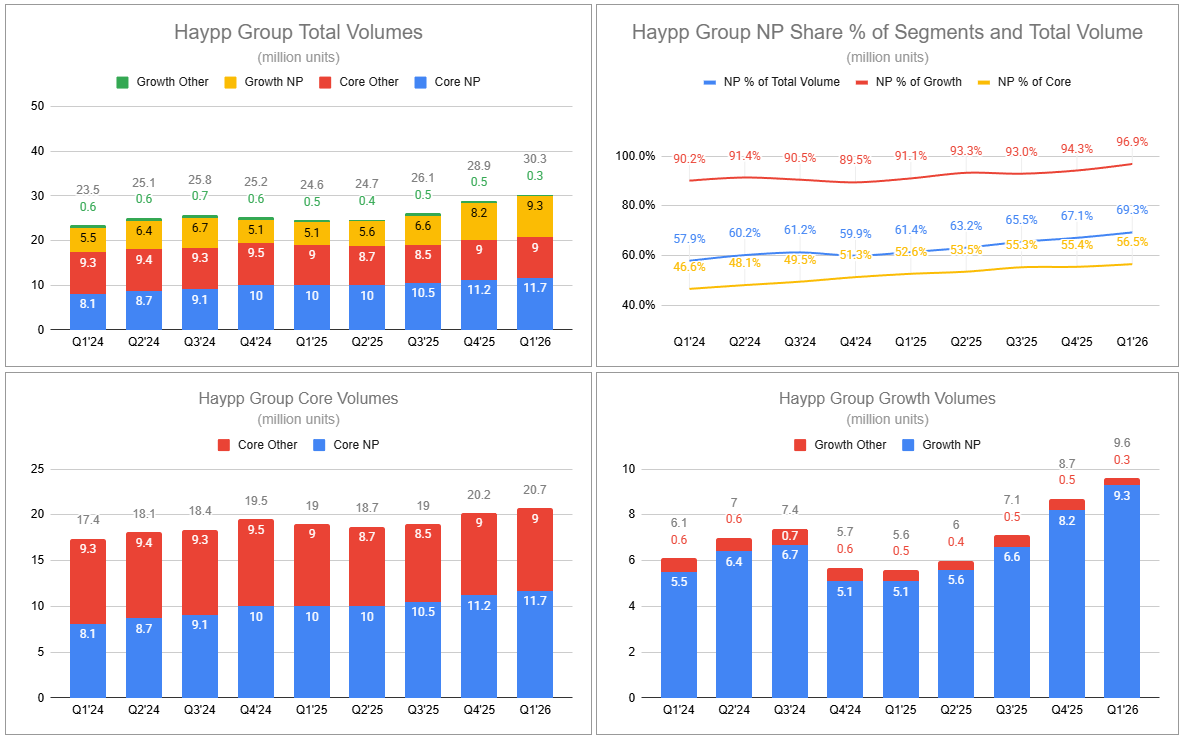
Group and segment total volume and share of NP
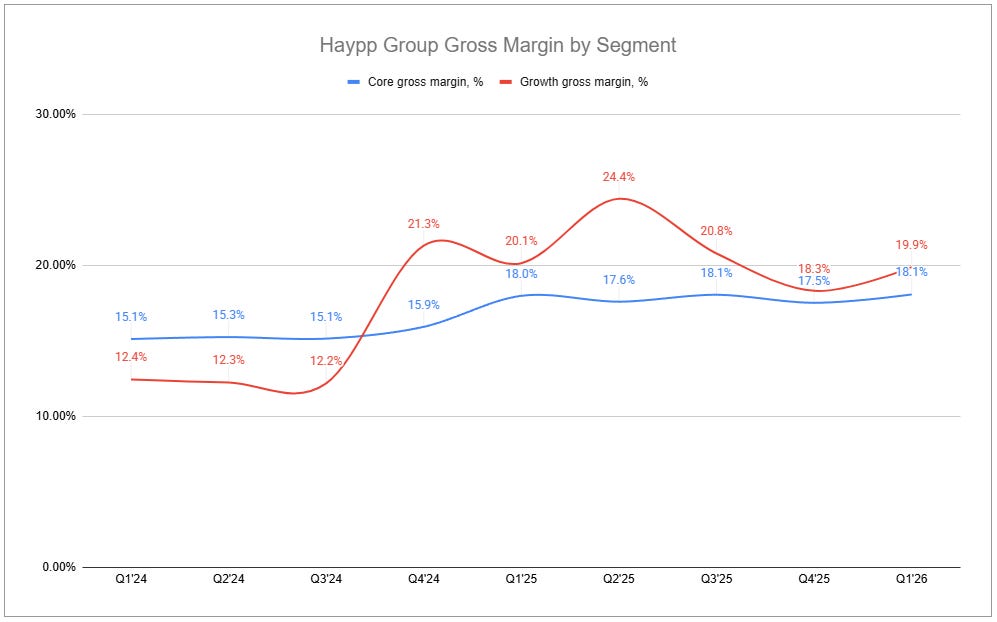
Gross margin by segment
Group sales by revenue stream (product vs Media & Insights)
Group overhead cost breakdown by Marketing, Fulfillment, and General & Administrative
In addition, as of Q1’26, the Emerging segment was integrated into the Core and Growth segments, with Sweden EM placed in Core and UK and Germany EM placed in Growth. When a company changes its reporting structure, questions begin to stir. Why? Is this obscuring anything important? Fortunately, last month, when Haypp Group announced this change in reporting, such thinking concluded without worry. HnB and Vapor sales have never been part of the central thesis, and since halting UK vapor sales was already known, the change in segment reporting appeared logical. This is a business driven by nicotine pouches, and the Q1’26 report shows Haypp Group’s unrelenting focus is paying off.
This isn’t to say that this change in reporting should be entirely dismissed. In a way, it rewrites history.
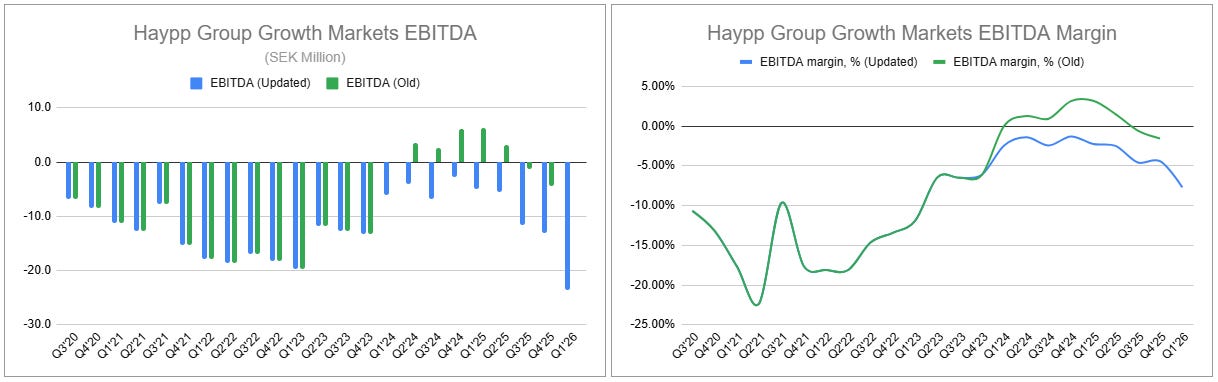
Prior to the integration of the Emerging segment, the Growth segment officially inflected to positive EBITDA in Q1’24. The Growth segment then experienced meaningful margin expansion through Q1’25. This was despite the ZYN shortage extending to the online channel, as M&I demand rapidly grew, and alternative products in the United States sported more attractive margin dynamics at the time. The Growth segment remained profitable in Q2’25 before turning back negative in Q3’25, and then carried deeper EBITDA losses in Q4’25 as the company expanded its investment efforts, primarily in the United States and the UK.
That entire arc is meaningful. Some had questioned whether the business model, proven to work in established Core Markets, would be viable in Growth Markets. For those investors, the inflection to profitable Growth Markets was a necessary check mark. Not to mention that, now that segment gross profits are disclosed, there is a concrete demonstration that Growth Markets are structurally capable of being more profitable than Core Markets. This is another check mark, although not a surprise, as the structural elements explaining this differential have already been well-explored.
It is interesting to contemplate how someone entirely new to analyzing Haypp Group might view the business, now that Emerging has been split and tucked back in. Through this new lens, the Growth segment shows a -2.4% EBITDA margin in Q1’24, rather than an inflection to profitability. In fact, looking through its recast history, there is no quarter in which Growth sports a positive EBITDA margin. Over the last few quarters, increased investments in the central Growth operations (pouches) have led to meaningful margin decline. Q1’26 Growth EBITDA margin was -7.7%, more deeply negative than all periods back through Q2’23. Despite the implications of new disclosures at the gross level, might Growth EBITDA cause new observers to miss key context about what has been happening under the hood of the segment? I think so.
There is an even more meaningful implication due to the change in reporting. It could easily be missed and requires further context.
Q1’26 shows Growth segment volumes increasing by 71% year-over-year, with nicotine pouches growing by 83%. These are, by all measures, large figures and the fastest growth rates in recent history. The company’s presentation specifically highlighted the US and UK, where nicotine pouch volumes grew by over 100% in Q1’26.
These growth rates were partly driven by existing active consumers purchasing more. A larger driver was the increase in Active Consumers. Regaining a direct supply of ZYN aided this, but it is also evidence that Haypp’s increased marketing and enhancements to deliver outstanding value to consumers are bearing fruit. Q1’26 shows Active Consumers in the Growth segment increasing by 66.4% year-over-year, and by 6.2% sequentially, reaching 192.1 thousand.
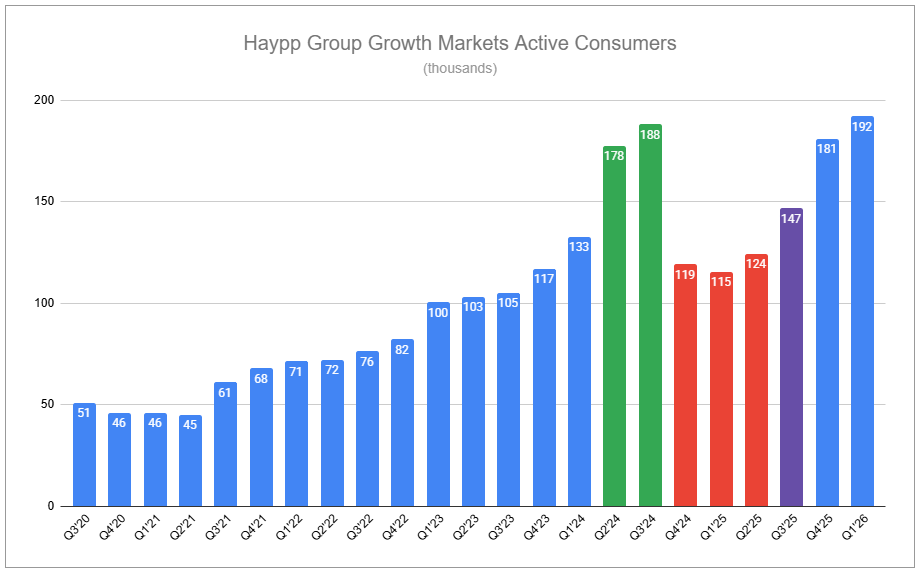
These are the reported figures. However, ignoring the nuances of the ZYN shortage across offline and online channels, there is reason to believe that the true underlying growth rate of Active Consumers in Growth Markets is not captured.
Keep reading with a 7-day free trial
Subscribe to Invariant to keep reading this post and get 7 days of free access to the full post archives.