
Edgar M. Cullman's Brilliance

“Sometimes I get upset that I wasn’t able to do more with the cigar business, turn it into something more than it was. We made some great cigars, and it never occurred to me that I’d lose the business altogether. Selling out in the end to Swedish Match was a very difficult thing.” - Edgar M. Cullman, Cigars and Other Passions, p.280-281
It is odd, but perhaps not all that surprising, that a man who had achieved so much still wished he could have done more.
Founded in 1861, Schmidt & Storm was a New York partnership focused on the manufacturing of cigars. Shortly after the end of the Civil War, Frederick Storm renamed the company Straiton & Storm to reflect the contributions of partner John Straiton, with Schmidt officially retiring only a few years later. The firm’s earliest brands were well-constructed and always offered at affordable prices, providing the company with a commendable degree of success.
By 1890, Frederick Storm’s other business and personal efforts had grown enormously in size. He had bought significant land south of Bayside Station and spent years developing it. With greater aspirations, including meaningful involvement in politics, he stepped down from leading the company, handing over the reins to George and Henry.
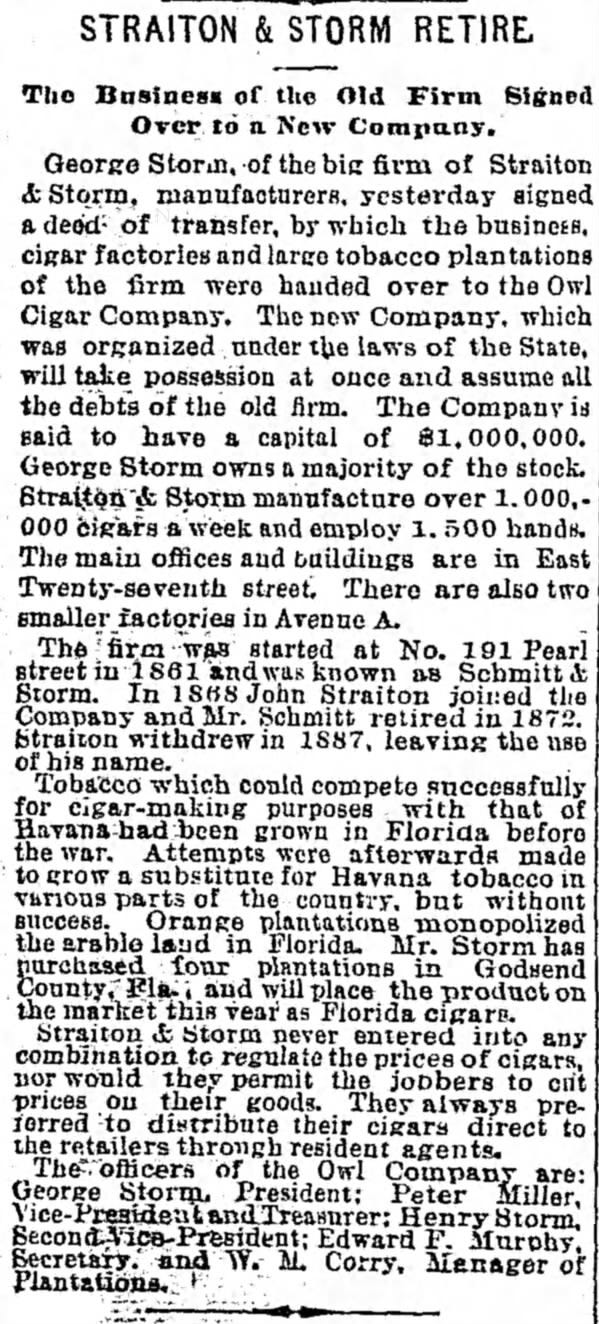
George Storm led the business for roughly seven years, until 1897, when Straiton & Storm was bought out by Kerbs, Wertheim & Schiffer, consolidating its operations to within its existing cigar manufacturing footprint. Then, in 1899, the American Tobacco Company acquired Kerbs, Wertheim & Schiffer’s cigar concerns (several years before ATC made more significant efforts to break into the US cigar market).
The Supreme Court ruling for the dissolution of the American Tobacco Company for violation of the Sherman Anti-Trust Act in 1911 altered the trajectory of all tobacco categories. Operations were split into major concerns of their own, with the majority of its owned domestic cigar brands allowed to be tucked into the aptly-named American Cigar Company, a standalone business sharing the same name as the prior trust subsidiary.
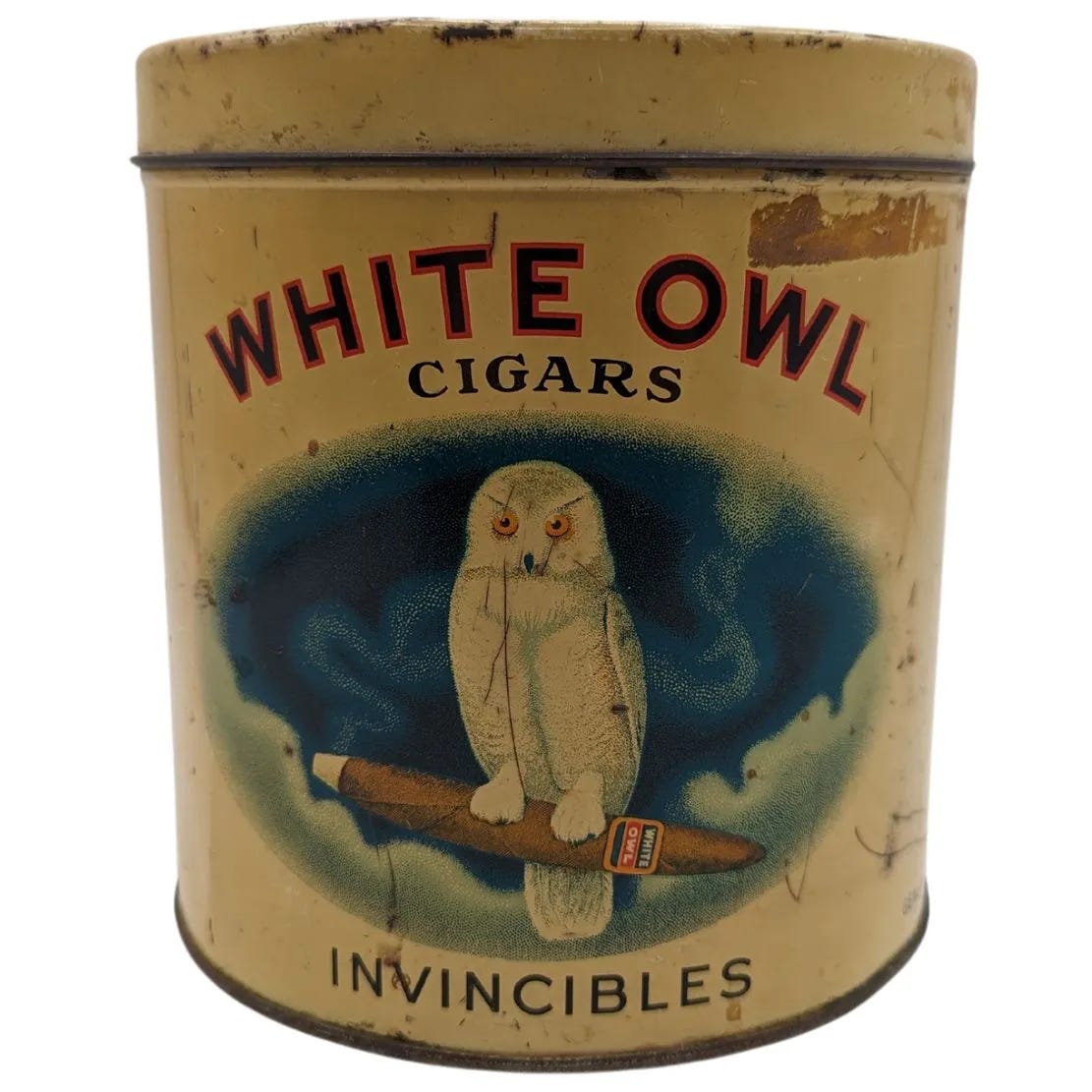
The original Owl brand cigars, first made by Straiton & Storm, faded. It was General Cigar Company, founded in 1906, that would give the bird a second life. Drawing inspiration from the original Straiton & Storm brand, but without acquiring any assets, the company launched White Owl Invincibles in 1917.
There are several family names that immediately come to mind as being synonymous with tobacco. Duke. Reynolds. Cullman.
Edgar M. Cullman was born on January 7th, 1918. His great-grandfather, Ferdinand (Kullman) was a tobacco merchant. His grandfather Joseph and uncle Jacob founded a tobacco trading firm, Cullman Brothers. His father, Joseph Cullman Jr., owned prime Connecticut River Valley farmland that was the source of prized Connecticut Shade tobacco for cigar wrappers. Following the 1929 stock market crash, the family bought the Webster Tobacco Company. In 1941, Joseph Cullman Jr. and Edgar’s uncle, Howard S. Cullman, acquired the famed cigarette brand Benson & Hedges. Edgar’s older brother (by six years), Joseph Frederick Cullman III, would go on to serve as chairman and CEO of Philip Morris. There are few families in the tobacco world as dynastic.
Edgar Cullman, graduating from Yale in 1940, was provided an entry-level job rolling cigars at H. Anton Bock. From the ground up, he learned how the factory worked and earned skills related to handling high-grade tobacco leaf. Naturally, he found his way back to working for the family business.
With the family largely dealing with the cultivation and trade of tobacco, Edgar realized there was a significant opportunity in vertical integration, gaining stability and capturing value through manufacturing. He set his eyes on Bayuk Cigars (the very same company Warren Buffett would eventually make a tremendous return on). Edgar formed a group of investors to buy up shares. However, their efforts fell short, failing to gain enough votes to see the deal all the way through, as several large shareholders had no interest in selling. Undeterred, Edgar kept hunting.
In 1961, having built masterful knowledge of his trade, and with significant family resources and connections, Edgar formed an investment group to acquire General Cigar Company, with investors comprised of himself, family members and firm, the Haas family (owners of Levi Strauss), and the Ford Foundation. The group acquired 37% of the business, paying approximately $25 million, and increased its stake to 45% the following year. The exact numbers are not attainable, but the operations were described as “very profitable”, underpinned by mass-market White Owl, William Penn, Van Dyck, and Robert Burns brands.
The timing of the deal could not have been any better. While the core business was set to produce respectable profits, two key events set the stage for brilliant execution. The first was the U.S. embargo on Cuba, which applied partial restrictions in 1960, but became a full trade embargo in February 1962. Prior, Cuban brands made up a massive part of the U.S. handmade cigar market and represented nearly all imported sticks. The embargo forced domestic manufacturers to shift sourcing, blends, and production while maintaining appeal with consumers. Edgar had already been toying with creating handmade cigar blends using other tobaccos from tropical and sub-tropical regions, but nothing of scale previously materialized as Cuban tobaccos enjoyed advantaged import duty rates. The embargo represented a sea change.
Then, in 1964, Surgeon General Luther Terry released his report on the health risks of smoking. While this created significant uneasiness within the industry, it was actually a boon for handmade cigars. Over the following years, an increasing number of the public began to believe that smoking caused cancer, but, since handmade cigars are consumed without inhalation of smoke, many consumers shifted their consumption.
General Cigar Company purchased Gradiaz Annis & Co., the maker of Gold Label, a premium product that fetched roughly 4-5x the average price of the company’s existing brands on a per-stick basis. Then, in 1969, the company purchased the Temple Hall factory in Jamaica. This would prove to be brilliant.
Temple Hall produced a variety of brands, some of which it owned, and others for major manufacturers, including British American Tobacco. Its owned brands were fairly insignificant in terms of prestige or market size. But it did own one small brand that was produced for export to the UK: Macanudo. Edgar had General Cigar’s master blenders reformulate Macanudo, using Dominican, Jamaican, and Mexican fillers. The brand began to utilize Connecticut Shade wrapper leaf, sourced from the Cullman family farms. Most notably, these wrapper leaves were aged for several years, the first for the industry.
Competition struggled to adjust to the dynamic market. Many lacked the proper infrastructure. Others with adequate infrastructure did not have the capabilities or wherewithal to age wrappers for multiple years, preventing them from competing on flavor. Mass-market cigars faced challenged sales following the Surgeon General report, but premium handmade cigars accelerated, and Macanudo drove significant sales growth for General Cigar, becoming the #1 selling brand in the United States.
Edgar continued to show his brilliance. Ramon Cifuentes, the head of the family-owned Partagas brand, left Cuba following the government nationalizing major cigar factories. In 1974, after many talks with Edgar, the Cifuentes family agreed to sell General Cigar the brand rights to Partagas, the first major brand with Cuban heritage to be manufactured using New World leaf and facilities. Priced at a premium above Macanudo, the brand exploded in popularity.
In 1978, General Cigar registered the brand “Cohiba” in the United States, which was granted in 1981. Sales were slow. But the Cubans began to sell Cohiba-branded cigars outside of the United States. General relaunched Cohiba to take advantage of the name association. This resulted in a significant legal battle, with Cubatabaco petitioning the U.S. Supreme Court against General’s use of the Cohiba name. The court ultimately denied the petition, allowing General Cigar to build yet another truly great New World brand. General Cigar would go on the acquire Villazon in 1997, giving it non-Cuban varieties of other renowned Cuban brands, including Hoyo de Monterrey and Punch.
While not without periods of extreme challenge, the long-term success of handmade cigars led to Swedish Match’s (now owned by Philip Morris International) interest and subsequent involvement, acquiring a controlling stake in General Cigar’s premium operations, the merging of General Cigar with Scandinavian Tobacco Group, and the splitting of brands based on mass-market and premium subsegments.
Edgar M. Cullman passed away on August 28, 2011. His commitment to quality and consistency will continue to live on through the many brands he birthed.
If you enjoyed this piece, hit “♡ like” on the site and give it a share.
Questions or thoughts to add? Comment on the site or message me on Twitter.
Ownership Disclaimer
I own positions in Scandinavian Tobacco Group and other tobacco companies such as Altria, Philip Morris International, British American Tobacco, and Imperial Brands. I also own positions in Haypp Group, a major online retailer of reduced-risk nicotine products.
Disclaimer
This publication’s content is for entertainment and educational purposes only. I am not a licensed investment professional. Nothing produced under the Invariant brand should be thought of as investment advice. Do your own research. All content is subject to interpretation.
Fantastic breakdown of Cullman's timing and execution. What really stands out is how he didn't just benefit from the Cuban embargo but actualy positioned himself before it with the General Cigar acquisition, then built infrastructure (Temple Hall, aged wrappers) that competitors couldn;t easily replicate. I've always found that the best opportunities come from structural shifts that require long-term capability building, not just quick pivots.