
Flash in the Pan

“Rude contact with facts chased my visions and dreams quickly away, and in their stead I beheld the horrors, the corruption, the evils and hypocrisy of society, and as I stood among them, a young wife, a great wail of agony went out from my soul.” - Victoria Woodhull
On September 23, 1838, in the small town of Homer, Ohio, Victoria California Claflin was born. Six years later, her younger sister, Tennessee Celeste Claflin, was born. As numbers seven and ten of the Claflin kin, they had a peculiar upbringing, to put it mildly. There was little education to be had, and their perspectives toward and understanding of the world were nearly wholly shaped by their parents’ proclivities.
Their mother, Roxanna Claflin, was superstitious, illiterate, and held an obsession with rituals and spiritualistic medicine. She was known for sudden outbursts, preaching various scriptures with an almost possessed-like enthusiasm. Their father, Reuben Claflin, was, simply, a conman. He traveled, acting as a trader, always on the hunt for unsuspecting marks to dupe.
Opportunities, and therefore money, were scarce for the family. The Claflins owned an old, worn grain mill that brought the family more headaches than income. Characteristically, Reuben set the mill on fire, hoping to collect the insurance proceeds. It is no surprise that arson and attempted fraud were quickly uncovered.
Making ends meet evolved into a group effort. The Claflin family became a traveling medicine show. The parents sold a variety of elixers, purported to cure almost all ailments. Each bottle was mostly a mix of low-quality alcohols and various herbs. The girls contributed in their own ways. Victoria presented herself as a fortune teller and claimed to communicate with spirits while in a trance-like state. Tennessee was peddled as a shaman with the ability to heal by mere touch alone.
The girls’ teenage years were especially fraught. Victoria crossed paths with Canning Woodhull, a man who presented himself as a doctor but appeared to have no formal education or qualifications. In 1853, the two married. Victoria was fifteen years old. Exceedingly rare for the time, after more than a decade of Canning proving himself to be little more than a deadbeat alcoholic, Victoria was granted a divorce, though she kept the surname.
Around the same time, Victoria’s father, Reuben, established a ‘medical facility’ in Ottawa, Illinois, by renting the entire hotel. He titled himself “The King of Cancer” and began promoting Tennessee’s healing abilities more aggressively. In 1864, police raided the establishment after hearing accounts of the family using primitive methods, such as applying lye directly to patients’ skin. The family would face charges of disorderly conduct, fraud, and other offenses. Tennessee was charged with manslaughter after the death of one patient. The family hit the road once again, fleeing before the legal ramifications played out.
Again on the road, hunting for new targets while avoiding accountability for past misdeeds, the family found themselves in New York. In 1868, Reuben would identify the ultimate mark: shipping and railroad tycoon Cornelius Vanderbilt. It was perfect. Cornelius was ungodly wealthy and willing to spend. By then, he was in his mid-seventies and already had a keen interest in spiritual healing practices. He had also recently lost his wife, making the spirit-talking services of Victoria particularly appealing.
Vanderbilt was immediately intrigued and took great interest in the sisters. It was rumored, although never officially confirmed, that he and Tennessee became romantic partners, with a roughly half-century age difference. What was confirmed, however, was that both sisters were spending considerable time with Vanderbilt, accompanying him throughout the day. This proximity proved to be extremely valuable. Vanderbilt began openly discussing the financial transactions he was making, and the sisters would coattail those trades in their own accounts, long before Vanderbilt’s actions were fully public. While the exact figure is uncertain, it is said that the two turned a modest sum into more than $700,000 in just a few months, a considerable fortune for the time.
In 1869, the sisters opened the first female-owned brokerage house in the country, Woodhull, Claflin & Company, in the heart of Manhattan’s financial district. Not only was the firm funded by the sisters, but it also received direct financial support from Cornelius Vanderbilt himself. The combination of being sisters with purported supernatural powers alongside continuing to act on information fed by Vanderbilt generated enormous publicity. Newspapers across New York began to run headlines. The client list rapidly grew to include widows, women of high society, business owners, actresses, and, notably, the female heads of brothels.
Just a few months after the sisters formed their brokerage firm, they launched Woodhull & Claflin’s Weekly, a newspaper renowned for being founded and edited by women. The paper’s purpose was threefold. The first was as a massive advertising conduit to generate more business for the brokerage. The second was to promote women’s suffrage and labor reform, and to discuss other societal concerns. It also acted as a platform to announce Victoria Woodhull’s running for President of the United States, the first woman to run for the position.
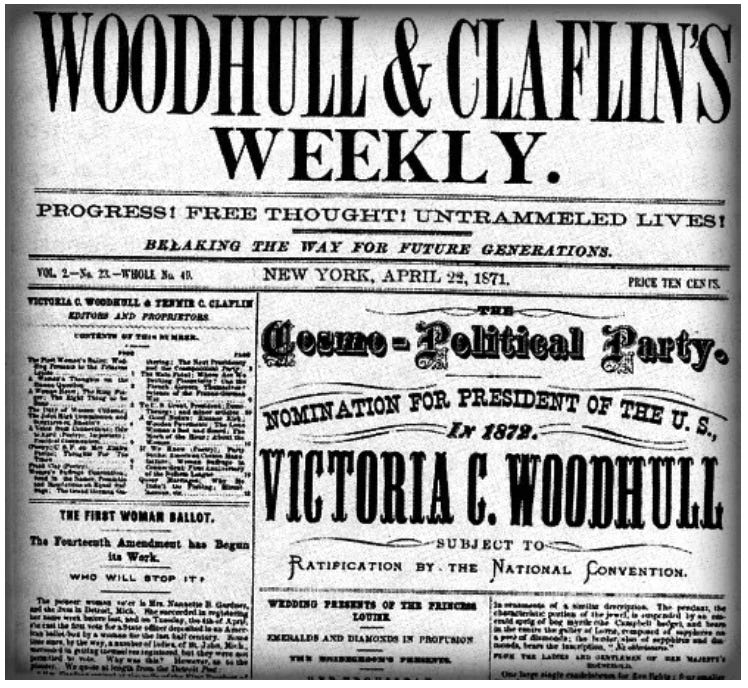
Woodhull & Claflin’s Weekly was not only the first newspaper to publish on so many social issues, but also the first American paper to publish the words and ideas of Karl Marx. It was the latter, entertaining ideas of communism, that eroded the relationship between the sisters and Vanderbilt. That erosion also meant less information being fed to the sisters, and trading performance at the brokerage began to falter. Allegations of impropriety began to fly, and in court, the sisters so much as admitted that they had conned Vanderbilt into believing their abilities. The court also publicized all of their past misdeeds. Relationships and reputations would be strained further after Woodhull & Claflin’s Weekly published a salacious story about the misdeeds of a well-known preacher. The nature of the article violated recently passed obscenity laws, causing the sisters to spend time in jail, including Victoria being stuck in jail on the election day of 1872.
Without guidance, insider information, and additional financing, Woodhull, Claflin & Company was aimless. Their speculative bets, including those on gold, became more aggressive. When the Panic of 1873 set in, there was no recourse. The firm was overextended and off-balance and was ultimately forced to close its doors.
On January 4, 1877, Cornelius Vanderbilt died. He left nearly all of his fortune to his son, William Henry Vanderbilt. Other potential heirs immediately initiated legal proceedings to contest the will. One lingering concern was that Woodhull and Claflin would devise a scheme to claim a share of the estate. To combat this risk, the Vanderbilts paid each $100,000 to leave the country, ensuring they would not be available to contest the stated will or to act as a witness in any potential proceedings. They fled to England, pursuing alternative routes to increase their wealth, each marrying a wealthy, well-respected businessman. While each went on to engage in various forms of lecture, philanthropy, and otherwise, neither returned to commanding capital. For Woodhull and Claflin, their success in navigating markets was nothing more than a flash in the pan.
The tale of Woodhull and Claflin demands comparison to their contemporary, Hetty Green. They operated in the same time period, and while Hetty did indeed travel, she spent considerable time in New York, walking the same streets of Victoria and Tennessee, doing business dealings with some of the very same people. Naturally, those points are where similarities largely end, and contrasts become unignorable.
While the sisters came from very little, Hetty was born into a prominent, well-to-do family. Victoria and Tennessee were taught to scheme, while Hetty was provided a strict education and was quickly given roles in the family’s bookkeeping. Each was given a meaningful sum of money. However, Victoria and Tennessee received theirs from victims of their scams, while Hetty’s was an inheritance. Not to mention, Hetty’s starting capital was much more vast.
Perhaps the greatest contrast was in disposition. Victoria and Tennessee saw capital as a means to build fame and to amplify their voices. Once with money, they mingled in high society and continually looked to build confidence in others they could exploit. Conversely, Hetty treated capital as the means and the end. It was a tool used to compound itself, and that was all that mattered. Hetty had no interest in mingling in high society. Her only interest was to grow her fortune. She was focused, shrewd, and operated with unmatched discipline, demonstrating many of the value-oriented principles later taught by Benjamin Graham and popularized by Warren Buffett. A key demonstration of such contrast lies in reexamining the Panic of 1873. While it was disastrous for
Woodhull, Claflin & Company, Hetty used the crisis to amplify her fortune, bailing out banks, rails, and others, while pessimism was at a fever pitch.
Hetty’s legendary words still ring:
I buy when things are low and nobody wants them. I keep them until they go up and people are crazy to get them. That is, I believe, the secret of all successful business.
Thanks for reading. Enjoy this piece? Hit “♡ like” on the site and share it.
Questions or thoughts to add? Comment on the site or message me on Twitter.
Disclaimer
This publication’s content is for entertainment and educational purposes only. I am not a licensed investment professional. Nothing produced under the Invariant brand should be thought of as investment advice. Do your own research. All content is subject to interpretation.
Great story