
The Nicotine Window

“The chances for a problem to rise on the decision agenda are dramatically increased if a solution is attached.” - John W. Kingdon
It has been more than a decade and a half since I began following the tobacco industry with great interest. Since then, little has changed in the core investment theses of related businesses. The major firms sport enviable margins and, relative to sales, require minimal capital reinvestment, allowing them to convert dollars into free cash flow exceptionally well. Despite the enormity of those cash flows, it has long been my view that the industry, broadly, has been mispriced. This mispricing largely stems from two key sources.
One such factor is the rise of ESG-focused investing. Although ‘E’, ‘S’, and ‘G’ are all important, they have been perversely packaged into disjointed methodologies to incorporate non-financial considerations into financial decisions. To reject any one industry not on grounds of sound financial evaluation but for reasons related to moral disgust, principled outrage, obscure mandate, or otherwise, pushes ownership of that industry to others at discounted prices.
A second key factor has everything to do with how investors value growth, or rather, how they measure growth. There is a principal fixation on volumes, and in the tobacco industry, a near-obsession with cigarette volume declines. The jump in logic is that volumes will continue to decline and, at some point, hit zero, and that without volumes there will be no profits. Such lines of thinking ignore the fact that no business lasts forever, and overly reductionist approaches to calculating terminal value miss a key truth: negative-volume-growth industries are fertile hunting grounds for the discerning investor.
Most aversion to investing in anything to do with nicotine is predicated on one or both of the above points. Yet, when measured coldly, uniformly, in terms of what truly matters, earnings and the durability thereof, counterarguments quickly bubble to the surface. If you measure from when per-capita cigarette volumes peaked in the U.S. in the early 1960s, or when absolute volumes peaked in the 1970s, to today, the industry’s profit pool has increased radically. Is this not a growth industry? Moreso, when overseeing capital, does an ethical duty exist to not blindly disregard the industry, considering the underlying stability, non-cyclicality, constant demand, and incredible pricing power?
Bond-like equities with ever-growing coupons, boring, stodgy, and oh so unglamorous. The nicotine industry moves forward, marching to the beat of its own drum. While the core thesis has not moved an inch over the last decade and a half, it would be irresponsible to say that additional considerations have not sprouted. Four years ago, I penned The New Era of Nicotine, laying out a thesis that would play out over many years: the rise of next-gen nicotine products would align the interests of consumers, governments, and producers.
Although the above idea can be distilled simply in hypothetical terms, how it will play out in the real world will be anything but. There is no concrete timeline, no cadence rule, and little uniformity in related developments across the globe. Rather than map potential trajectories, let us explore a key period before the endstate. To imagine it, we can look through two similar, yet distinct lenses.
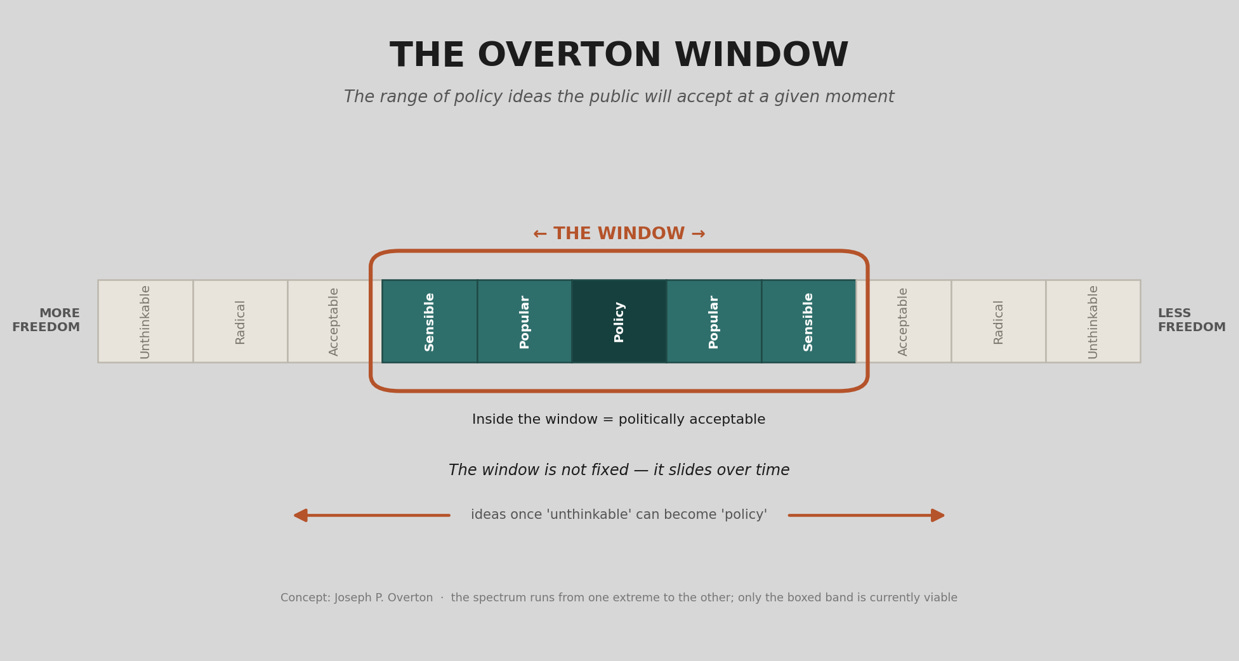
The first is the Overton Window, named after Joseph Overton, the American policy analyst who proposed that a position’s viability is contingent on where it sits on the spectrum of public acceptability. These ‘windows’ of viability can shrink or expand depending on the discourse that sways public opinion. It is the advocate, often at the fringes of the spectrum, who sways public opinion, a process that can take inordinate time. Politicians merely operate within a given window.
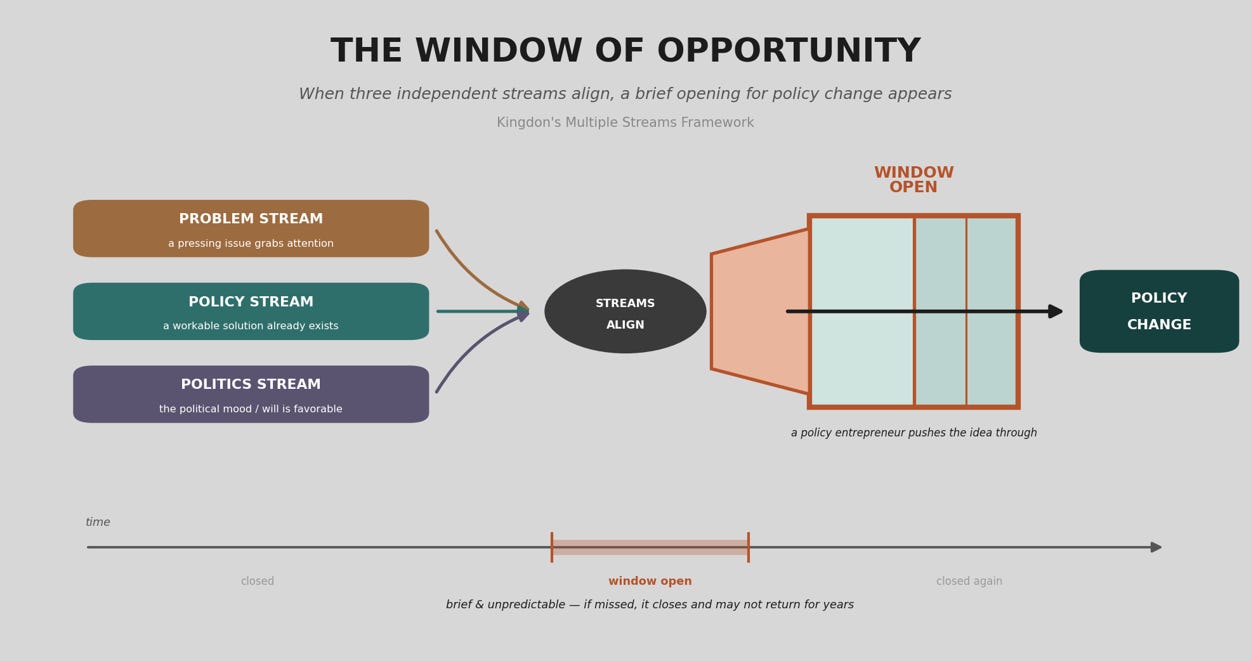
The second is the “Window of opportunity,” coined by political scientist John W. Kingdon in his 1984 book Agendas, Alternatives, and Public Policies. Rather than focusing on which positions are politically acceptable, this window focuses on when specific policies are proposed and enacted, as problem, policy, and politics streams merge. Under this framework, when such alignment occurs, politicians can inject pre-formed agendas (“solutions”).
Politics is not the only arena in which the window of opportunity exists. All business activity can be framed within windows of opportunity, factoring in the alignment of problem, solution, capital availability, competition, and regulation. Looking at the evolution of the U.S. tobacco industry over the last 120 years through these collective lenses provides key context.
Few have seized a window of opportunity more effectively than James Buchanan Duke. Entering the nascent cigarette category, embracing technological innovations such as the Bonsack Machine, and benefiting from changing taxation schemes, he created a new facet of competition, which ultimately led to a drastic degree of industry consolidation under the American Tobacco Company
Despite the cigarette acting as the first fulcrum that ATC used to gain leverage over the industry, cigarettes were still a relatively small category, dwarfed by the likes of chewing tobacco, pipe, and cigar. It was government actions, not the industry, that ultimately led to cigarettes becoming the leading product by volume. The forced dissolution of the American Tobacco Company in 1911 led to a significant increase in advertising across the tobacco industry, raising awareness of the still-nascent cigarette category. More critically, half a decade later, during World War I, cigarettes became a staple inclusion in standard field ration kits for the U.S. military. When General John Pershing was asked what America needed to win the war, he stated, “Tobacco as much as bullets.” The product was simple to use, relieved the immense stress of the battlefield, suppressed hunger, offered the comfort of home, and even served as useful currency for bartering with soldiers and civilians alike. Organizations such as the American Red Cross, the Knights of Columbus, and even the YMCA (which opposed smoking prior to the war) ran programs to provide the troops with cigarettes.
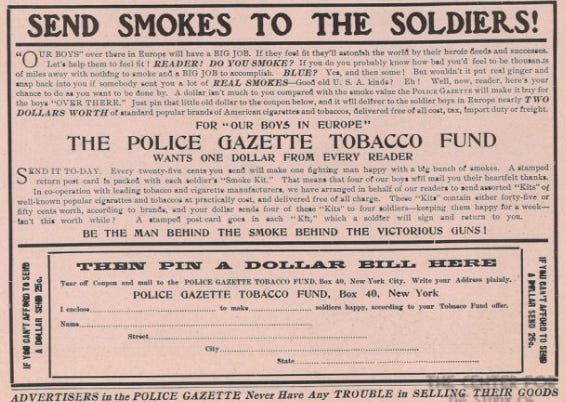
Government policies and supporting efforts placed cigarettes directly into the core of American culture. Millions developed the habit. Growth in industry volumes accelerated rapidly and was further amplified during World War II, when the U.S. military provided approximately 350 billion cigarettes to American troops.
Cigarette usage was ubiquitous, having been happily adopted and seen as a tool to help win two world wars. However, that acceptance would soon be challenged. In 1950, two studies connected strong statistical links between smoking and lung cancer, with Ernst Wynder and Evarts Graham publishing their findings in the Journal of the American Medical Association, and Sir Richard Doll and Sir Austin Bradford Hill publishing in the British Medical Journal. These findings established the problem stream, but there was no window of opportunity, as policy and political alignment were largely absent.
Over the next three decades, policy shifted in line with the Overton Window, which itself was shifted by health concerns sitting at the fringe of public discourse. It was only in 1975 that the U.S. Department of Defense halted the inclusion of cigarettes in military field rations. Smoking was no longer treated as just a danger to oneself and a personal choice. With an emphasis on secondhand smoke, smoking was painted as a scourge to all, swaying public opinion, and subsequent policy, to restrict places of use, raise excise, and engage in meaningful litigation. Smoking and smokers were stigmatized in order to ensure that the Overton Window continued to move in the direction that would allow for greater policy actions.
Following the MSA, meaningful policy actions have occurred, with the FDA gaining regulatory oversight of tobacco in 2009 being among the most consequential. Underequipped and with an incomplete mandate, the FDA was forced into a reactive stance as the industry embraced technological innovations that opened a new window of opportunity: next-gen products. Early efforts were predominantly led by home tinkerers and small startups rather than major industry participants. The majors also reacted, adjusting their strategies to keep pace with changes in consumer behavior.
The Ultimate Window
Over the last decade, we have seen monumental advancements in product innovation. Similarly, changes in consumer behavior have begun to accelerate. Conversely, we are witnessing radically different adoption rates, policies, and outcomes around the world.
At the positive end of the spectrum lies Sweden, the prime example of sensible policy which embraces Tobacco Harm Reduction (THR). Other developments, such as the FDA’s recent Guidance for Industry, set the stage for further, incremental advancement. At the other end are the anti-nicotine ideologues, pushing their agenda through category bans, heavy-handed restrictions, and even generational usage bans. To outsiders, the tension within and across countries may look to be building without end. Resolutions, however, are bound to come.
Prohibitionist policies throughout history have all failed in different ways. Current iterations will be no different. Likewise, generational usage bans are completely unworkable, as they introduce multiple problems and are disconnected from the issues they claim to solve. Over time, these failures are nearly certain to erode the public’s acceptance of the ideas underpinning such policy.
Awareness of the continuum of risk is still in its infancy. Research continues to scientifically substantiate the lower-risk profiles of NGPs and enforce the validity of THR-based policy frameworks. Education on this front will continue, but it is not strictly necessary to see consumers transition from legacy products to new offerings. Support for related products will grow, even if the science is not fully understood by the average consumer. Simply by using next-gen products, many of the benefits are self-evident. Smokers switching to vapor report improvement in stamina; able to work out, run, and even keep up when playing with their kids. Users of nicotine pouches recognize the anytime, anywhere convenience, and not only avoid the widespread public usage restrictions that are applied to cigarettes, but also entirely skirt judgment and social stigma. It does not take effort on the government’s part to reinforce the appeal of these products.
Historically, social stigma and the majority of regulations surrounding nicotine stem from the health-related harms of legacy tobacco products, predominantly combustible products. As aggregate nicotine usage shifts towards next-gen products, it stands to reason that support for THR-based policy will grow. Similarly, the Overton window will shift enough that anti-nicotine policies will become increasingly difficult to reintroduce.
On a long enough timeline, it appears inevitable that aggregate nicotine usage will grow as the chemical is destigmatized. However, the eventual end state poses certain challenges for major industry participants. Without stigma or concern, might regulations become lax enough to welcome a flood of new competition? It is conceivable that presently, and perhaps for the next decade or two, we will be within the Ultimate Window for current major industry participants:
Failure of existing prohibitionist-type attempts and the Eroding support for future restrictive policies
Growing acceptance of nicotine usage predicated on THR, leading to incremental demand
Not-yet widespread enough support of THR to dramatically reduce regulatory burdens, preventing new waves of competition
Policy “catch-up” occurring to classify next-gen products and enforce against illicit products
There remains a considerable number of opponents to nicotine, ensuring continued challenges. However, rather than hampering the industry, those very same groups are likely to inadvertently extend the Ultimate Window.
If you enjoyed this piece, hit “♡ like” on the site and give it a share.
Questions or thoughts to add? Comment on the site or message me on Twitter.
Ownership Disclaimer
I own positions in tobacco companies such as Altria, Philip Morris International, British American Tobacco, Scandinavian Tobacco Group, and Imperial Brands. I also own positions in Haypp Group, a major online retailer of reduced-risk nicotine products.
Disclaimer
This publication’s content is for entertainment and educational purposes only. I am not a licensed investment professional. Nothing produced under the Invariant brand should be thought of as investment advice. Do your own research. All content is subject to interpretation.
Really thoughtful perspective. Loved this piece.
Great article and a thoughtful history of the industry for someone, like myself, with limited context.